
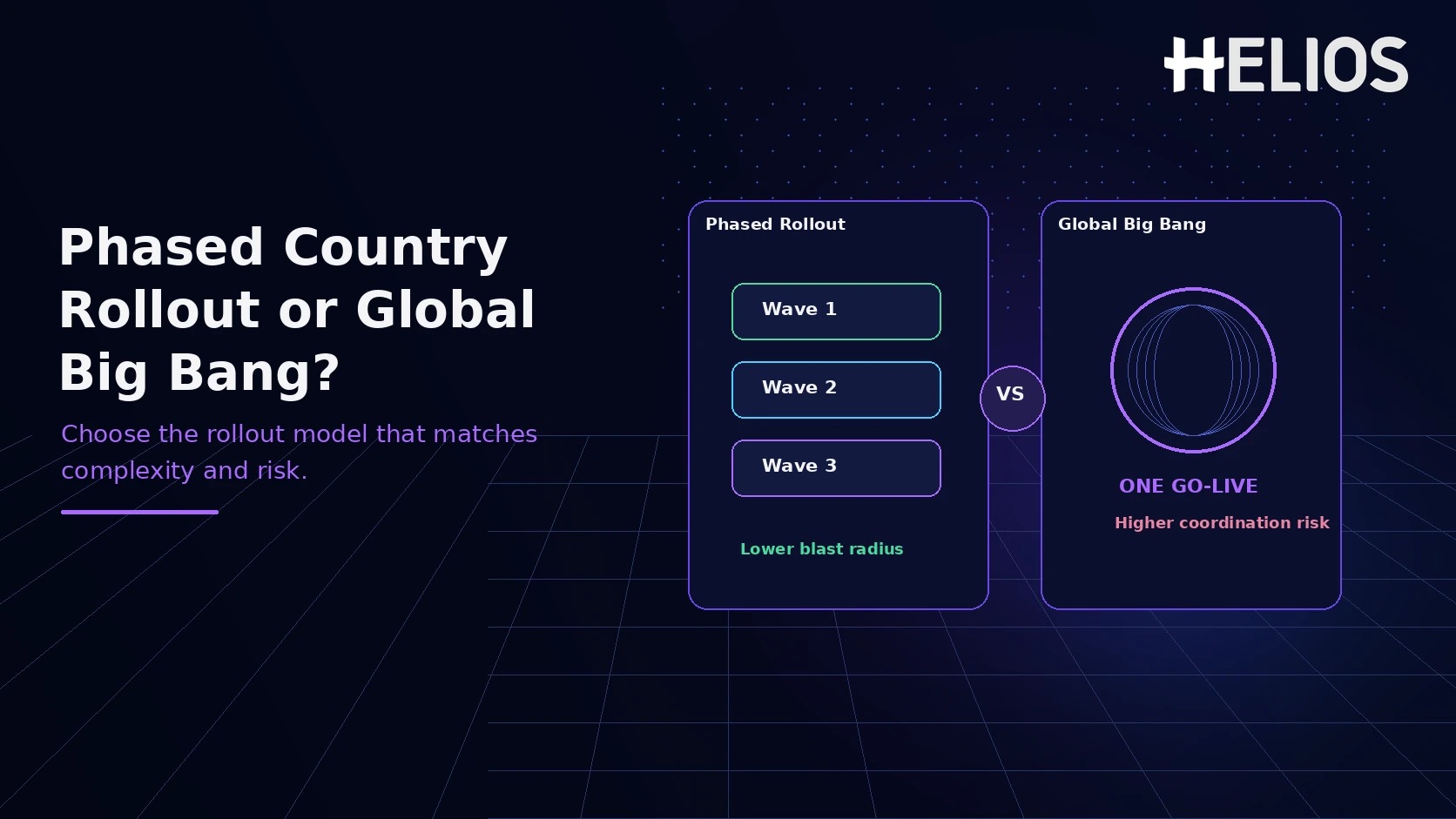
A new expense system affects far more than the screen employees use to submit receipts. It touches approval routing, policy checks, corporate-card transactions, tax fields, ERP posting, reimbursement timing, employee support, and audit records. In a multinational, each country can add its own currencies, legal entities, payment routes, local policies, and operating habits.
That is why the choice between a phased country-by-country rollout and a global big-bang rollout is really a decision about where implementation risk should sit. A big-bang concentrates change into one coordinated cutover. A phased rollout spreads change over time and creates opportunities to learn, but it also extends the period in which old and new processes may coexist.
For most complex multinationals, the strongest default is a global design with phased country activation. A big-bang can still be the better choice when processes are already highly standardized, integrations are consistent, data is clean, and the organization can absorb a concentrated support and cutover load.
What the Two Rollout Models Actually Mean
A phased country-by-country rollout activates the new expense platform in waves. One country, legal entity, business unit, or regional cluster goes live first; the program stabilizes that cohort; then the next wave begins. The target operating model can still be global even though activation is staggered.
A global big-bang rollout activates the new platform for all in-scope countries and entities on one coordinated cutover date. This can shorten the coexistence period, but it also means configuration errors, integration defects, training gaps, and support issues can appear at enterprise scale at the same time.
Why a Phased Rollout Is Usually Safer for Multinationals
The main advantage of phased rollout is not simply lower speed. It is the ability to create controlled learning loops. A program can find a defect in one wave, fix the template, and avoid repeating the same issue across every later country.
- Lower blast radius. An integration or configuration issue affects a defined cohort instead of the entire enterprise.
- Better reimbursement protection. Payment queues, open claims, approval aging, and employee support can be monitored closely during each cutover.
- Faster learning. Problems found in the pilot or first wave can be corrected before later countries migrate.
- More realistic change management. Training, communications, local champions, and hypercare can focus on one group at a time.
- Stronger local validation. Country finance teams can confirm tax, policy, currency, payment, and approval requirements before activation.
The trade-off is program duration. A phased approach requires stronger governance because two systems or processes may coexist for longer. The program needs clear system-of-record rules, configuration control, and a disciplined wave-exit process so early and late countries do not drift into different operating models.
When a Global Big-Bang Rollout Can Be the Better Choice
Big-bang is not inherently reckless. It can be efficient when the environment is simple enough that the benefits of one coordinated cutover outweigh the value of incremental production learning.
- Processes are already standardized. There are few country-specific policy or workflow exceptions.
- The geographic scope is relatively simple. The organization has fewer countries, legal entities, or distinct user populations.
- Integrations are consistent. ERP, card, identity, and payment architectures are common across the in-scope organization.
- Data readiness is strong. Master data is harmonized and historical migration requirements are limited or well controlled.
- Change capacity is high. Leadership can fund enterprise-wide testing, training, communications, and a large hypercare organization.
The key test is whether the organization is genuinely simplifying complexity or merely compressing it into one weekend. If local differences remain unresolved, a global launch does not remove them; it simply makes them surface simultaneously.
Phased vs. Big-Bang: A Practical Comparison
| Dimension | Phased country-by-country | Global big-bang |
| Cutover scope | One country or wave at a time | All countries/entities at once |
| Risk concentration | Lower per wave | High at cutover |
| Learning opportunity | High; later waves benefit | Limited after go-live |
| Time to full global adoption | Longer | Potentially faster |
| Legacy/new-system overlap | Longer coexistence | Shorter coexistence |
| Change-management load | Distributed | Concentrated |
| Best fit | Complex multinationals | Highly standardized organizations |
The more local variation, integration diversity, and reimbursement complexity an organization has, the more value it usually gets from phased activation. The more standardized and centrally controlled the environment, the more realistic a big-bang becomes.
The Strongest Pattern: Global Template, Phased Activation
Many implementation teams frame the choice as either "global" or "phased." That is a false trade-off. A multinational can design one global operating model and still activate it in waves.
The global template should define common expense categories, policy principles, accounting logic, data definitions, approval design standards, security roles, integrations, reporting, and control ownership. Country teams should document only the deltas that are genuinely required for local regulation, tax, payment, or business operations.
This model avoids two common failure modes at once: a big-bang cutover that concentrates too much operational risk, and a country-by-country program that accidentally creates a different version of the new system in every market.
How Helios Can Support a Controlled Global Rollout
The implementation strategy and the product capability are separate decisions. Whichever rollout model is selected, the target platform should make global standardization easier while supporting justified local configuration. Three Helios capabilities matter most to this operating model:
- Flexible Approval Workflows. Configurable approval flows based on department, role, or cost center let a phased program reuse a global approval design while applying controlled local variations by wave — or let a big-bang program centrally validate the full approval structure before launch.
- Seamless Accounting Integration. Helios states that its accounting engine can generate journal entries from expense reports, which makes accounting validation an explicit rollout gate: teams should test mapping, posting, rejection handling, reconciliation, and downstream close processes before every wave or any enterprise-wide cutover.
- Intelligent Analytics & Reporting, plus **Service Copilot**. Dashboards and customizable reporting help the program monitor cycle time, exceptions, adoption, and financial control during stabilization, while Service Copilot reduces repetitive support demand by answering policy and travel questions closer to the point of need.
Automated Policy Control and a familiar mobile/Claim Copilot experience matter too — the former lets common controls be standardized while country-specific rules are tested rather than left in reviewer memory, and the latter reduces the learning burden for employees moving off a legacy system — but neither changes which rollout model is right for a given organization.
Related Helios pages: Helios platform | Spark AI | Helios Resources
How to Run a Country-Wave Rollout Without Losing Global Control
- Design the global template first. Define common policies, expense categories, master-data fields, approval patterns, accounting logic, security roles, integrations, and reporting. Do not let the first country become the template by accident.
- Segment countries into waves. Group entities by integration architecture, policy similarity, business criticality, user volume, language and support needs, and readiness. Avoid putting every difficult country into the first wave.
- Select a meaningful pilot. The pilot should be complex enough to test real integrations and reimbursement flows, but small enough that the team can contain issues quickly.
- Validate end-to-end scenarios. Test expense creation, receipt capture, card matching, policy checks, approval, accounting output, reimbursement, exception handling, support, and audit evidence.
- Publish system-of-record rules before cutover. Employees and finance teams must know which system handles new expenses, what happens to drafts and in-flight reports, and where historical records remain available.
- Run hypercare with daily controls. Monitor open claims, approval aging, reimbursement timing, card-feed completeness, accounting errors, support tickets, and policy exceptions. Reconcile by transaction rather than relying only on anecdotal feedback.
- Hold a formal wave-exit review. Launch the next group only when the prior wave has met operational, financial, technical, and adoption thresholds. Carry lessons into the next configuration baseline.
- Retire legacy scope deliberately. Remove access only after in-flight items are drained, required history is preserved, reconciliations are complete, and audit or retention obligations are satisfied.
If You Choose Big-Bang, Increase the Safeguards
A big-bang rollout removes the opportunity to learn from production waves, so the organization must move more learning into simulation, testing, and rehearsal before go-live.
- Run full-volume mock cutovers, including data loads, identity activation, interfaces, accounting output, and reconciliation.
- Test every major country archetype — not only headquarters or the simplest market.
- Freeze nonessential legacy changes so mappings and policy rules don't drift during final validation.
- Create a cross-functional command center: finance, IT, HR, payment, card, service desk, and vendor owners available during go-live.
- Define containment and rollback options — know what happens if a critical interface, reimbursement process, or workflow fails.
- Pre-stage support capacity: communications, local champions, office hours, and escalation paths for the enterprise-wide spike in questions.
- Treat reimbursement continuity as a critical service. Payment timing and backlog should be executive go-live metrics, not secondary project statistics.
Define Go/No-Go Criteria Before the Rollout Starts
A rollout should not proceed simply because the project plan says the date has arrived. Define quantitative and qualitative gates in advance so leaders can make a disciplined decision under pressure.
| Gate | Example evidence | Why it matters |
| Reimbursement continuity | No unexplained payment backlog; aging within target | Protects employee trust |
| Accounting integrity | Journal output reconciles to source transactions | Prevents close and audit issues |
| Integration stability | Critical interfaces pass and monitoring is active | Avoids downstream failures |
| Data quality | Employees, cost centers, approvers, policies validated | Reduces routing and posting errors |
| Support readiness | Known issues, FAQs, owners, escalation paths ready | Controls go-live demand |
| Severe defects | No unresolved severity-1 issues; severity-2 accepted by owners | Prevents avoidable disruption |
Which Rollout Approach Is Right for Your Organization?
Use phased country-by-country rollout when the business operates across many jurisdictions, has meaningful local policy differences, uses multiple ERP or card configurations, or has low tolerance for reimbursement disruption. This is the more common profile of a large multinational.
Use a global big-bang when the organization has already standardized the operating model, can prove data and integration readiness at enterprise scale, and has enough change-management capacity to support every country at once. Big-bang is a strategy for simple or highly controlled environments, not a shortcut for complex ones.
If the organization is in between, use the hybrid default: one global design, one governance model, one data standard, and phased activation by country or wave. This preserves the strategic benefit of a unified platform without concentrating all operational risk on a single day.
FAQ
Is phased rollout always slower? It usually takes longer to reach 100% global coverage, but later waves can benefit from earlier lessons and reduce rework. The better measure is time to stable, reliable adoption, not only the final cutover date.
How many countries should be in one wave? There is no universal number. Group countries by similarity and support capacity. A wave should be large enough to create efficiency but small enough that the program can monitor reimbursements, integrations, and user issues closely.
Should the first wave be the easiest country? Not necessarily. An extremely simple pilot can create false confidence. Choose a representative country with real integration and policy complexity, while avoiding the highest-risk market as the first production test.
Can a company use big-bang for one region and phased rollout globally? Yes. Rollout architecture can be nested. A standardized region may cut over together while the broader global program still proceeds in waves.
How long should the legacy expense system stay available? Long enough to drain in-flight claims, preserve required history, complete reconciliation, and meet audit or retention obligations. Legacy access should have a defined end-state and owner.
What should executives monitor during rollout? Reimbursement cycle time, payment backlog, approval aging, accounting failures, interface health, support volume, adoption, policy exceptions, and severe defects — these show whether the new system is operationally stable, not merely technically live.
Conclusion
The real success measure isn't the cutover date — it's whether employees keep getting paid on time and finance can close cleanly through every wave or the single go-live.
To explore the target operating model, visit Helios. For AI-assisted claims, approvals, and policy support, explore Spark AI. You can also browse the Helios Resources hub for more expense-management guidance.