
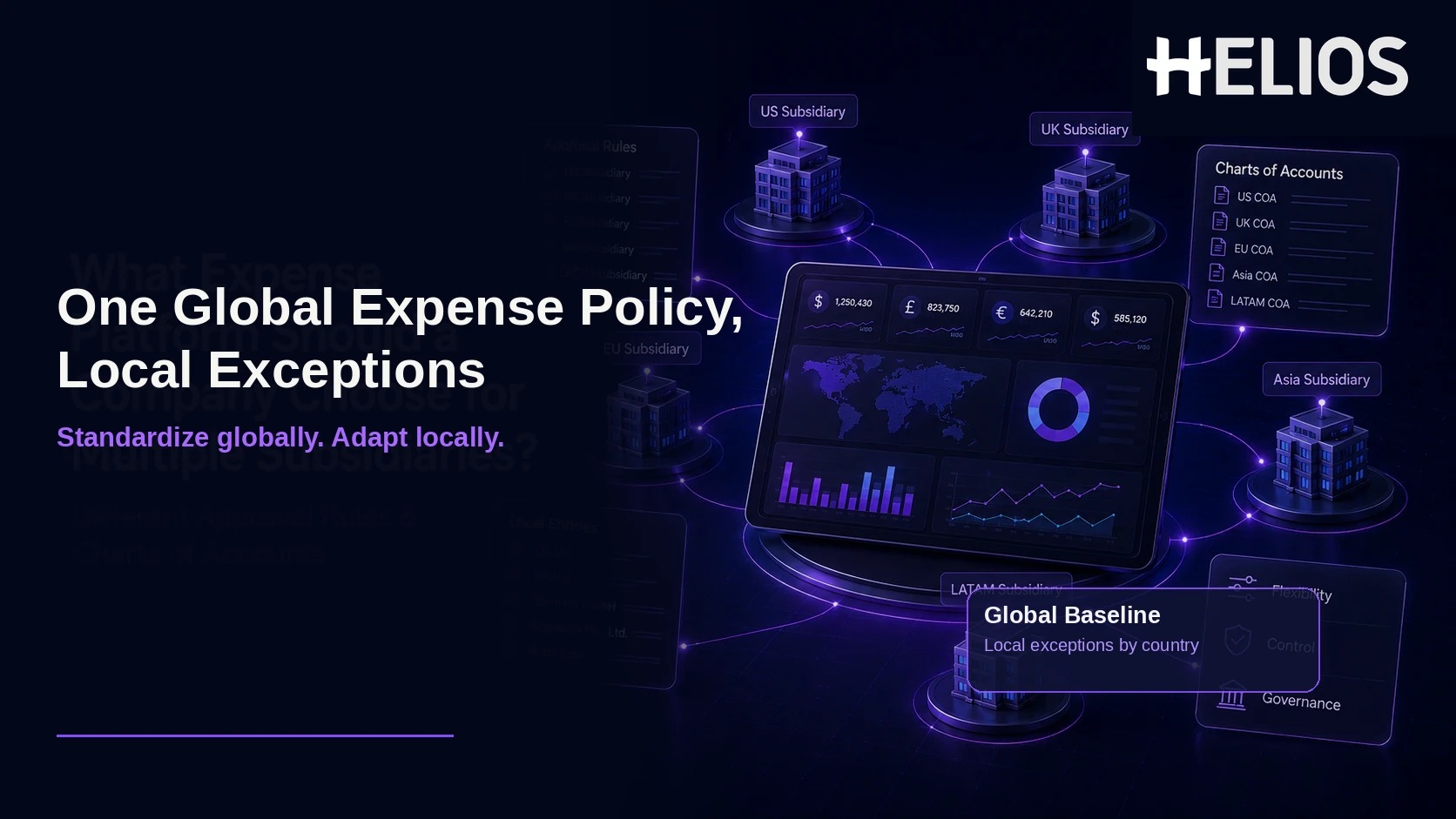
A multinational expense policy has to solve two problems that pull in opposite directions. Finance wants one set of principles, definitions, controls, and reporting standards so employees know what is expected and leaders can compare performance across the group. Local teams, however, operate under different tax rules, receipt requirements, per diem practices, currencies, labor expectations, banking structures, and cost levels.
The answer is not to choose between one rigid global policy and dozens of unrelated country policies. A scalable design uses a global baseline for what should be consistent, then allows a controlled layer of local exceptions where a legal, tax, market, or operating reason justifies the difference. Every exception should have an owner, a documented rationale, an effective date, and a review process.
For organizations consolidating regional tools into a global expense platform, this policy architecture is as important as the software itself. The system should encode the policy hierarchy rather than force finance to manage exceptions in spreadsheets and email.
What Should Be Global in a Multinational Expense Policy?
Start by identifying the rules that express the company's control philosophy rather than local market conditions. These should remain consistent wherever possible so employees and reviewers understand the same basic expectations.
- Business purpose and eligibility. Define which costs are legitimate business expenses, who can claim them, and what information must explain the business purpose.
- Core expense categories. Use shared definitions for travel, meals, lodging, transport, entertainment, mileage, supplies, and other common spend so reporting remains comparable.
- Approval ownership. Establish minimum approval principles, segregation of duties, self-approval restrictions, escalation, and documentation of exceptions.
- Evidence and traceability. Require the source receipt or invoice, claim data, policy result, approver action, reimbursement status, accounting treatment, and later correction to remain connected.
- Policy exception discipline. Define who may approve an exception, what evidence is required, and when a recurring exception must be converted into a formal local rule.
- Finance data standards. Keep a common minimum data set for entity, department, cost center, project, employee, category, currency, tax, and business purpose.
Where Local Exceptions Are Legitimate
Local exceptions should exist because the environment differs, not because a region prefers its historical process. A useful test is whether the exception can be tied to law, tax, market economics, banking, employee practicality, or a documented operating model.
- Tax and statutory evidence. Local VAT/GST, e-invoicing, tax invoice, withholding, or document-retention requirements may change what evidence must be captured.
- Per diem and mileage. Rates, eligibility, taxable treatment, and permitted calculation methods may vary by jurisdiction or company practice.
- Market-sensitive limits. Hotel, meal, transport, and other thresholds may need country or city bands when one global amount would be unrealistic.
- Reimbursement and currency. Employees may need different payout currencies, bank methods, or processing timelines because of local banking and employment practices.
- Entity-specific approvals and accounting. The legal entity, cost center, project, tax code, ledger, or chart of accounts may determine who approves and how the expense posts.
The design principle is simple: local variation may change the parameter, owner, or documentation requirement, but it should not quietly remove the global control objective.
Global Baseline vs. Local Exception: A Practical Matrix
A policy matrix helps finance separate genuine local requirements from inherited preferences. Keep the global column short and principle-based; use the local column only for differences that have a clear reason and owner.
| Policy area | Global baseline | Local exception when justified |
| Expense categories | Use one common category framework and definitions. | Add local subcategories only where tax, statutory reporting, or material business needs require them. |
| Receipts and evidence | Define when evidence is required and what a valid business purpose contains. | Adjust documentary requirements for local tax, e-invoicing, digital-receipt, or statutory rules. |
| Spending limits | Set global default limits and escalation principles. | Use country or city bands where market costs make the default unreasonable, with documented guardrails. |
| Per diem and mileage | Use a consistent methodology and ownership model. | Apply locally required or approved rates, eligible trip types, and tax treatment. |
| Approvals | Standardize role ownership, segregation of duties, and escalation logic. | Map local entity, cost-center, project, or statutory approvers without changing the control objective. |
| Currency and reimbursement | Define approved payment methods, FX principles, and service expectations. | Use local reimbursement currencies or payment methods where banking or employment practices require them. |
| Accounting and tax | Standardize required finance dimensions and traceability. | Map local chart-of-accounts, VAT/GST, withholding, entity, and ledger requirements. |
Use a Three-Layer Policy Architecture
A scalable policy is easier to maintain when it is designed in layers rather than copied country by country.
- Global principles. Define the non-negotiable intent: business purpose, ethical use of company funds, evidence, approval accountability, segregation of duties, data integrity, and compliance with applicable law.
- Global defaults. Set the standard categories, receipt logic, default limits, approval patterns, expense fields, reimbursement expectations, and reporting dimensions used unless a local overlay says otherwise.
- Local overlays. Add only the country, legal-entity, or market rules that differ. Each overlay should state exactly which global rule it changes, why it changes, who approved it, and when it will be reviewed.
This approach also makes system configuration cleaner. Instead of maintaining twenty unrelated policies, finance can reuse one baseline and apply a smaller number of controlled overrides.
How to Govern Local Exceptions Without Creating Policy Sprawl
The hardest part of a global policy is not writing the first version; it is preventing exceptions from multiplying until the policy becomes regional again. Governance should make every local difference visible and reviewable.
- Require a named owner. A country finance lead may propose an exception, but global finance, tax, legal, HR, or another accountable function should approve it according to the subject.
- Document the reason. Record whether the exception is legal, tax-driven, market-based, operational, or temporary. "This is how we have always done it" should not be enough.
- Set effective and review dates. Time-bound rules are easier to retire, while permanent rules should be reviewed on a regular cadence and when regulations or operating models change.
- Define rule precedence. Employees and systems need to know whether the global baseline or a local overlay takes priority when both could apply.
- Measure exception volume. Repeated overrides, manual rerouting, or frequent policy waivers can indicate that a local rule is poorly designed or that the global default needs revision.
How to Implement the Policy in an Expense Management System
Policy design should translate into structured configuration. If the system cannot express the hierarchy clearly, finance will recreate it through manual review.
- Build the organization and finance data first. Confirm legal entities, employees, departments, cost centers, projects, currencies, managers, approver roles, tax fields, and accounting mappings. Policy routing is only as reliable as the master data behind it.
- Configure the global defaults. Set common required fields, receipt logic, categories, default limits, approval principles, exception reasons, and finance-review triggers.
- Add controlled local overlays. Parameterize local thresholds, tax evidence, per diem or mileage rules, reimbursement currencies, and entity-specific approval paths instead of creating separate offline policies.
- Test conflict and edge cases. Use claims that cross entities, currencies, thresholds, projects, delegates, missing receipts, policy exceptions, local taxes, and accounting corrections. Verify which rule wins and why.
- Monitor and refine. Track exception rate, returned claims, approval time, manual rerouting, policy overrides, reimbursement time, accounting corrections, and recurring local questions. Use the data to simplify the policy over time.
For complex structures, an automated approval workflow should route the right local owner without forcing employees or finance to manually choose approvers.
How Helios Supports a Global Policy with Local Exceptions
A three-layer policy design only works if the system can actually enforce the global-vs-local split, not just document it. Two Helios capabilities map directly onto that requirement:
- Automated policy control. Helios can enforce company spending rules automatically and surface out-of-policy requests. A global rollout can use this control layer to apply default rules consistently while testing local limits and documentation requirements where needed — the mechanism that keeps a "global default, local overlay" design from collapsing back into manual review. For example, a global €120 daily meal limit might carry a documented €180 overlay for a small list of high-cost cities; the policy engine would need to apply the higher figure only when the claim's entity or cost center matches that overlay, and flag everything else against the €120 default — exactly the kind of rule-matching a demo should be asked to prove, not assume.
- Flexible approval workflows. Approval paths can be configured around department, role, and cost center, which helps preserve a common control model while still routing claims to different local or entity-level owners — the approval-ownership layer that a global baseline needs to survive contact with real country structures.
Neither capability replaces the harder work of deciding which rules stay global and which get a local overlay — that judgment still belongs to finance, tax, and legal. Organizations with many entities should validate the platform against their real multi-entity expense management requirements, including tax, reimbursement, accounting, permissions, and local support.
Common Mistakes to Avoid
- Copying a separate policy for every country. This creates duplicated text, inconsistent definitions, and change-management problems. Use overlays instead.
- Making every local preference an exception. Reserve local rules for a documented need, not historical habit or managerial preference.
- Hard-coding the policy into manual review. If finance must remember country differences from spreadsheets or email, the design will not scale.
- Allowing exceptions without expiry or ownership. Undocumented permanent exceptions are how one global policy slowly turns back into many regional policies.
How to Measure Whether the Global Policy Is Working
A policy is successful when it improves both control and usability. Track exception rate, missing documents, returned claims, manual rerouting, approval time, reimbursement time, accounting corrections, and the share of claims following the standard path. Use automated expense reporting to compare results by entity and country and identify where a local overlay or global default needs revision.
Final Takeaway
Standardize what defines the company's control philosophy; localize only what law, tax, market cost, or banking genuinely requires. If your current policy looks closer to twenty regional documents than one governed baseline, the three-layer model above is worth testing against your highest-friction country next.
FAQs About Global Expense Policies
Should every country have the same expense limits?
Not necessarily. Keep one global methodology and default limits, but allow documented local bands where market costs, tax rules, or operating conditions justify them.
How many local exceptions should a global policy allow?
There is no fixed number. Keep exceptions only where there is a clear legal, tax, market, banking, or operating reason, and review whether repeated exceptions should become formal local rules.
Can expense software manage one global policy with local rules?
Yes, if it supports configurable policy checks, organization data, local parameters, approval routing, accounting mappings, and reporting. Test representative countries and exceptions before rollout.