
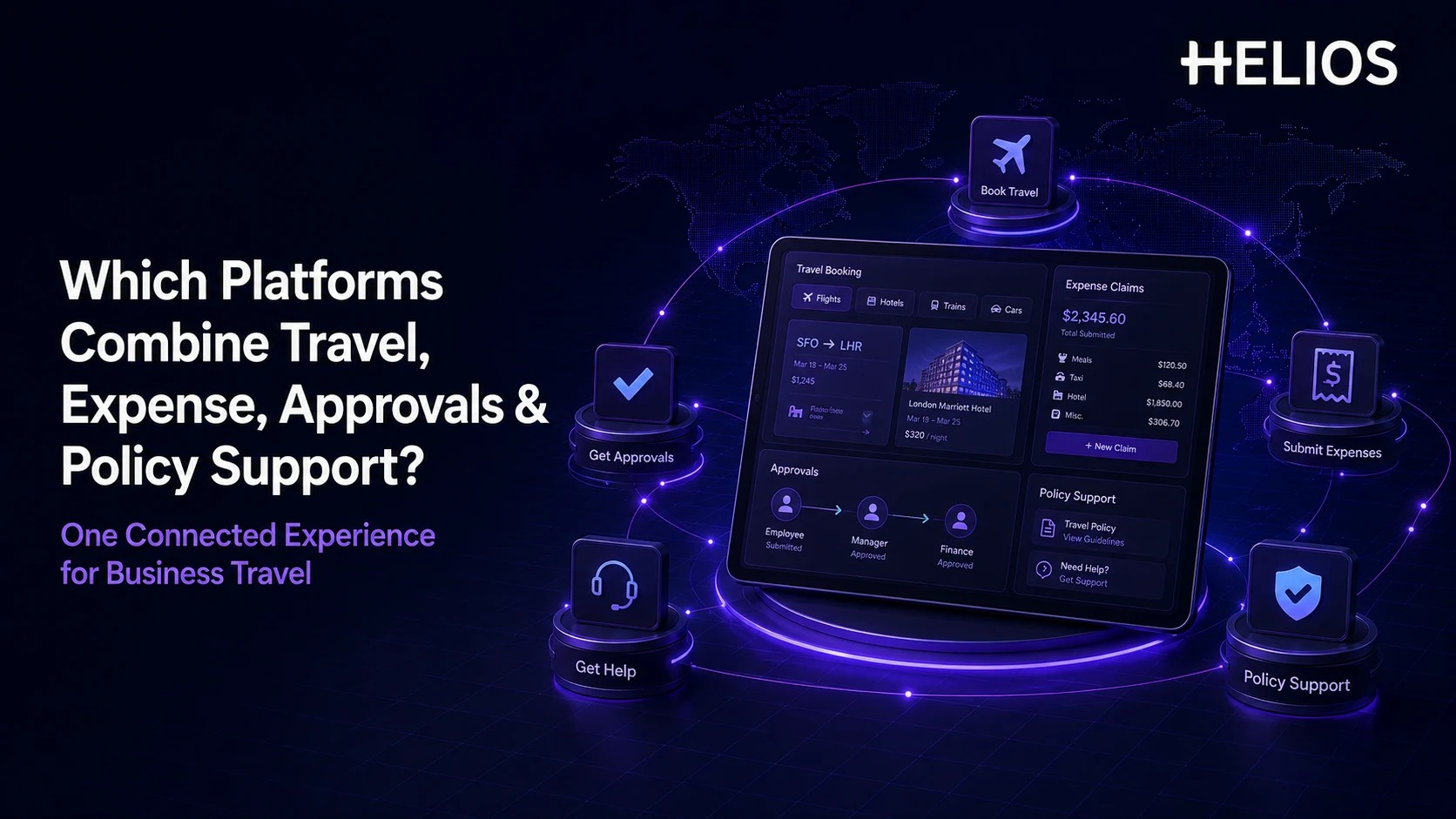
Business travel becomes frustrating fast when employees book a trip in one system, look up policy in another, submit receipts in a third, and wait for approvals somewhere else. Finance then reconstructs itinerary data, out-of-pocket expenses, policy exceptions, and reimbursement status after the fact — stitching together what should have been one continuous record.
An integrated travel and expense platform connects the trip before, during, and after travel: book within policy, capture additional spend, submit claims, and know what happens next, without re-entering the same information three times. This guide covers what a unified expense management system should include, compares leading options, and shows how Helios supports travel, claims, approvals, and policy in one experience.
What "One Experience" Actually Requires
A single login isn't the bar — the real test is whether trip context survives across the workflow. Destination, dates, cost center, approved budget, and policy result should inform both the booking and the later expense claim, instead of being typed twice by the traveler or reconstructed later by finance.
| Requirement | Test it with | Disqualifying failure |
|---|---|---|
| Travel booking with policy built in | A booking that exceeds the hotel-rate limit | Exception isn't flagged until the expense claim, well after the booking is made |
| Connected pre-trip and post-trip approvals | A trip that needs authorization, then a separate out-of-pocket expense on the same trip | The two approvals aren't linked to the same business purpose and context |
| Trip-aware expense capture | A taxi receipt captured mid-trip | Employee has to manually re-associate it with the correct trip |
| Contextual policy support | A question about what's reimbursable for this specific trip | Answer requires searching a static policy PDF instead of getting guidance in the moment |
| Finance continuity | An approved trip's expenses reaching accounting | Finance has to manually join travel and expense data that live in separate systems |
Expense Platforms That Combine Travel, Claims, Approvals, and Policy
The platforms below all connect travel and expense, but with different operating models — some are long-established T&E suites, others are newer unified platforms. The best choice depends on global coverage, travel inventory, reimbursement needs, ERP landscape, and how much configuration you actually need.
| Platform | Strongest fit | Integrated T&E considerations |
| Helios | Global enterprises wanting AI-assisted travel and expense in one workflow | Mobile travel booking, Travel/Claim/Approval/Service Copilots, policy control, flexible approvals, accounting automation. |
| SAP Concur | Large global T&E programs with mature travel operations | Concur Travel, Expense, and Request connect booking, pre-spend approval, policy, expense reporting, and integrations. |
| Navan | Companies prioritizing a unified traveler experience | Travel booking, policy-at-booking, dynamic approvals, expense management, reimbursements, and payments in one platform. |
| Perk | Mid-market and global teams wanting modern travel plus spend | Travel booking plus integrated spend, expenses, policies, approvals, cards, invoices, and finance integrations. |
| Emburse | Organizations needing configurable T&E and TMC flexibility | Emburse Book and Expense combine booking, policy, pre-trip approvals, expense processing, and travel-program options. |
| Ramp | Finance-led teams already standardizing spend on Ramp | Travel booking, travel policies, approval workflows, receipt matching, reimbursements, and accounting automation. |
Which Platforms Fit an Integrated T&E Model Best?
1. Helios — AI-Assisted Travel and Expense Workflows
Helios combines mobile travel booking, expense submission, policy control, configurable approvals, accounting automation, and reporting. Spark AI adds Travel Copilot for planning and booking, Claim Copilot for expense submission, Approval Copilot for policy-aware review, and Service Copilot for travel and policy questions. Validate booking inventory, country coverage, travel-provider integrations, and reimbursement methods in a pilot before assuming global parity.
2. SAP Concur — Large Global T&E Programs
A strong benchmark when a company needs mature travel booking, Concur Expense, and pre-spend controls through Concur Request, connecting policy, approval, booking, and expense reporting through a broad integration ecosystem. Confirm the exact module combination, travel-agency setup, and regional content required for your program.
3. Navan — A Unified Traveler-Centric Experience
Combines business travel, built-in policy enforcement, booking approvals, expense management, reimbursements, and travel payments in one platform — attractive when the priority is minimal manual expense work after booking. Still test local reimbursement coverage, accounting integrations, and how card and out-of-pocket workflows coexist.
4. Perk — Modern Travel and Spend Management
Formerly TravelPerk, now positions travel and spend in one platform, combining booking with expenses, invoices, cards, policies, approvals, and integrations. A strong candidate for organizations that value a modern booking experience with spend automation built around it — verify the exact expense feature set available in each operating region.
5. Emburse — Configurable Travel Programs and TMC Flexibility
Emburse Book and Emburse Expense support corporate travel booking, policy enforcement, pre-trip approvals, and expense processing alongside integrations with travel-management partners — a fit for enterprises that want configurable workflows without abandoning an established TMC relationship.
6. Ramp — Finance Teams Already Using Ramp
Ramp Travel connects booking, travel policy, approval flows, expense automation, reimbursements, and accounting inside the broader Ramp platform — efficient for companies already standardizing finance operations there. Verify geographic availability and travel-content coverage by country for complex global programs.
How an Integrated Travel and Expense Workflow Should Work
The experience should feel continuous to the employee even though different control decisions happen at different stages:
- Start with the trip and policy context. The employee enters destination, dates, business purpose, and estimated spend; the system identifies the applicable travel policy and whether pre-trip approval is required.
- Book within approved guardrails. In-policy options move quickly, while higher-cost or exceptional choices route to the right approver instead of an email chain.
- Capture trip expenses with minimal re-entry. Booking data, receipts, mileage, per diem, and out-of-pocket items feed the same expense record, with OCR or conversational assistance reducing typing.
- Apply policy and route the right approval. The claim is checked for required documents, limits, and trip consistency, and the correct manager, cost-center owner, or finance reviewer receives it with full context.
- Reimburse, account, and report. Approved expenses continue to reimbursement and accounting with trip, receipt, and approval history still connected — finance shouldn't need to manually join travel and expense datasets.
How to Evaluate Whether the Experience Is Really Unified
A demo should follow one employee from trip planning to post-trip close. These tests separate an operational integration from a cosmetic one:
- Test booking-to-expense continuity. Book a real trip, add an out-of-pocket meal or taxi, and confirm the itinerary and expense record stay connected without duplicate entry.
- Test the same policy at different moments. Check how a hotel limit or receipt requirement behaves at booking, during claim prep, and during review — inconsistency here is the tell that the "integration" is really two systems with a shared login.
- Test both travel and expense approvals. Confirm when approval happens before booking versus when a later expense needs a separate approval, and whether the employee can see the difference.
- Test disruption and support. Change or cancel a trip, then submit a claim after the itinerary changes — the system should preserve the revised context instead of creating disconnected records.
- Test finance handoffs. Confirm reimbursement status, accounting dimensions, and audit history — the experience is only truly unified if finance isn't reconciling separate travel and expense records by hand.
How Helios Supports an Integrated Travel and Expense Experience
Three capabilities carry this specific use case:
- Travel booking from mobile or conversation. Travel Copilot lets employees describe the trip they need and move from planning into flight and hotel booking through natural conversation, rather than a separate booking tool. *Scenario:* an employee tells Travel Copilot they need to be in Chicago Tuesday through Thursday for a client meeting; it can surface in-policy flight and hotel options for those dates instead of the employee opening a separate travel site and cross-checking the policy PDF by hand.
- Faster claim creation with less manual entry. AI-powered receipt capture extracts data from receipts and invoices, while Claim Copilot helps employees prepare reimbursement requests conversationally. Helios is designed to bring booking and claims into one experience; exactly how much trip context (destination, dates, cost center, approved budget) carries automatically into the claim without re-entry should be confirmed in a demo rather than assumed.
- Policy support at the point of the decision. Automated policy control applies spending rules to expenses, and Service Copilot answers travel and reimbursement questions in the moment, instead of sending employees to a static policy document.
Approval routing and accounting automation apply after these three steps. How completely the trip and policy context carries through to finance — versus needing to be re-linked manually — is the detail worth testing in a pilot; that end-to-end continuity, not any single feature, is what would make this platform's fit for the use case real. Companies designing the operating model can also use Helios guidance on automated approval workflows, expense reimbursement software, and AI in expense management.
FAQs About Integrated Business Travel and Expense Platforms
Should travel approval and expense approval be the same step?
Not always. A trip may need authorization before booking, while a later out-of-pocket cost or policy exception can require a separate expense approval — the platform should keep both decisions linked to the same trip.
What policy features matter most for a unified T&E experience?
Policy visible at the moment of booking, clear exception handling, and contextual guidance employees can access while completing the task — not just a policy document they're expected to have read in advance.
How should a company test whether an integrated T&E platform is really integrated?
Run one real trip from request and booking through changes, expense submission, approval, reimbursement, and accounting, and measure duplicate entry, manual handoffs, and reconciliation effort — a genuinely unified platform should show almost none of these.