
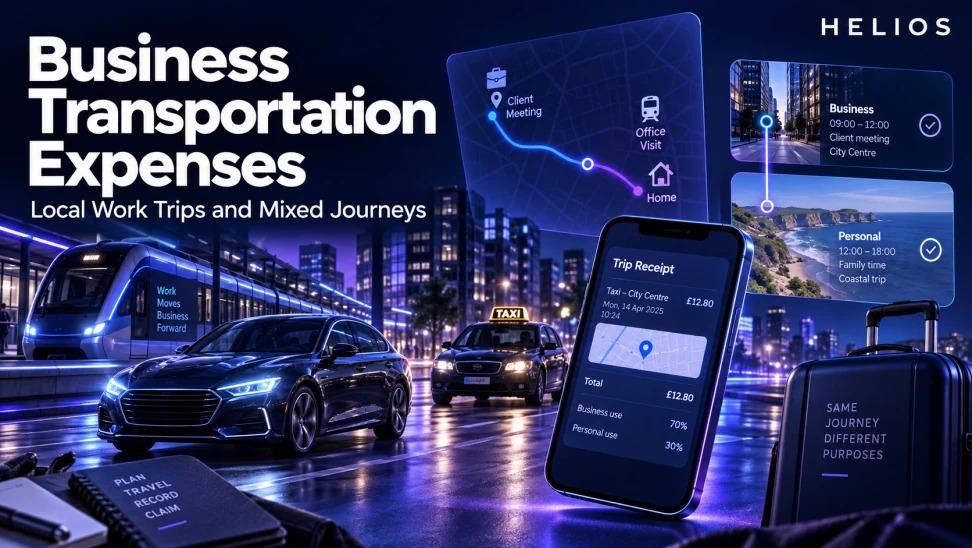
This policy guide focuses on local client visits, trips between work locations, and journeys that combine business and personal segments.
What finance teams need to know
This policy guide focuses on local client visits, trips between work locations, and journeys that combine business and personal segments.
Commuting, mileage, deductibility, taxable benefits, and evidence rules differ by country and individual circumstances. The article does not provide tax advice; employers should validate local policy and legal requirements.
For related guidance, see what are travel expenses.
The framework below turns the topic into defined inputs, owners, decisions, controls, and measures rather than a generic software overview.
Business Transportation Expenses at a glance
| Area | Definition | Owner | Control |
| Journey | Typical treatment | Required context | Review |
| Client visit | Potential business expense | Client and purpose | Manager |
| Inter-office trip | Potential business expense | Locations and reason | Manager |
| Normal commute | Usually outside reimbursement policy | Workplace definition | Local policy |
| Mixed journey | Business segment only | Allocation and route | Manager or finance |
| Emergency transport | Exception may apply | Safety or operational reason | Defined approver |
For related guidance, see global mileage reimbursement rules.
A practical operating model connects data, decisions, ownership, and follow-through.
Distinguish business travel from commuting
A trip from a normal workplace to a client, temporary site, or another office may be treated differently from ordinary home-to-work commuting.
Define normal workplace, temporary workplace, remote-work situations, and after-hours travel with local advisers.
For related guidance, see travel expense policy template.
Document the business purpose
Require the customer, project, meeting, site, event, or operational need. A vague label such as transport is not enough.
Calendar, itinerary, route, work order, and manager context can support the explanation where appropriate.
Handle mixed journeys
When a route combines personal and business stops, reimburse only the eligible business segment under company policy.
Document the business start and end, incremental distance or fare, allocation method, and approval. Do not make employees infer tax treatment.
Choose evidence by transport mode
Taxi and ride-hailing may require an itemized receipt and route. Public transit may use an electronic ticket. Personal vehicle claims may require distance, route, purpose, date, and vehicle-related fields.
Parking, tolls, fuel, rental cars, and mileage should not be duplicated for the same cost basis.
For related guidance, see multi-currency expense software.
Set approval and exception rules
Routine local trips may follow manager approval; higher value, unusual route, premium transport, missing evidence, or mixed travel may need added review.
Provide an exception route for safety, accessibility, service disruption, urgent work, or remote locations.
Support international teams
Use local distance units, currencies, languages, tax fields, and policy schedules. Keep a global definition of business purpose and evidence above local appendices.
Review local rates and rules regularly. A global system should not imply a single worldwide reimbursement treatment.
Measure transportation controls
Track missing purpose, mixed-journey adjustments, late claims, exception reasons, duplicate indicators, approval time, and spend by mode and location.
Use the data to clarify policy and improve preferred options without discouraging legitimate work travel.
How Helios supports this workflow
Helios can connect mobile expense capture, OCR, configurable policy controls, role-based approvals, accounting preparation, integration, and multidimensional reporting. Capabilities outside the confirmed product scope should be validated during implementation.
For related guidance, see automated travel expense reporting.
- Capture local transportation receipts on mobile.
- Use OCR to extract merchant, date, amount, and currency.
- Collect business purpose, project, route, and supporting details.
- Apply local policy schedules and exception workflows.
- Route claims to appropriate managers and finance reviewers.
- Report transportation spend and policy outcomes.
A practical conclusion
The strongest process uses explicit definitions, accountable owners, reliable evidence, and measures that reveal whether the intended decision actually improved.
See how Helios can support this workflow. Request a Helios demo.
FAQ about choosing an expense system for this need
What are business transportation expenses?
They are authorized transport costs incurred for work, such as client visits or travel between work locations, subject to company and local rules.
Is commuting reimbursable?
Ordinary commuting is often treated differently from business travel, but rules vary. Employers should define normal workplace and validate local requirements.
How should a mixed journey be claimed?
Document the business purpose, route, business segment, allocation method, and supporting evidence; claim only the eligible portion.
What evidence is needed?
Requirements may include date, route, purpose, receipt or ticket, distance, attendees or project, and approval.
Can fuel and mileage both be claimed?
Policies should prevent duplicate recovery for the same vehicle cost basis and define allowed methods.
How can Helios help?
Helios can support mobile capture, OCR, policy rules, approvals, international data, and reporting. Local reimbursement and tax rules still require validation.