
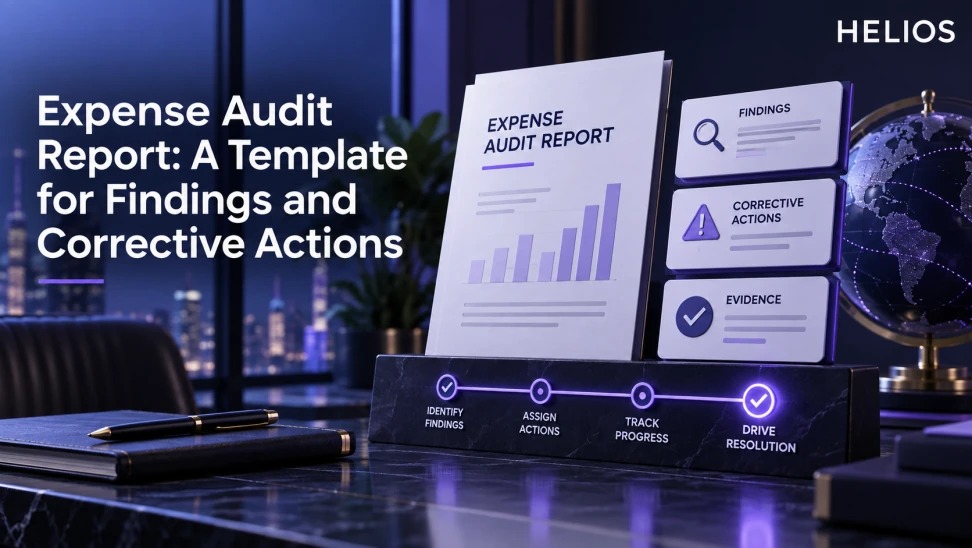
A practical expense audit report template covering scope, sample, facts, financial exposure, ownership, remediation dates, and closure evidence.
A practical framework for finance teams
A practical expense audit report template covering scope, sample, facts, financial exposure, ownership, remediation dates, and closure evidence.
Helios expense records and reports can support evidence gathering. This article does not claim that Helios automatically produces an external audit report or replaces auditor judgment, legal advice, or formal assurance procedures.
For related guidance, see AI audit best practices.
Start with a defined population, consistent evidence, named owners, and a decision that the analysis is meant to improve. The framework below connects each metric or workflow step to a control and a follow-up action.
Expense Audit Report at a glance
| Report field | Required content | Quality test | Owner |
| Scope | Period, entities, processes, exclusions | Reproducible boundary | Audit lead |
| Sample | Population, method, size | Selection explained | Reviewer |
| Finding | Condition, criteria, cause, effect | Fact-based and specific | Finding owner |
| Action | Task, owner, due date | Executable commitment | Management |
| Closure | Evidence and validation | Issue demonstrably resolved | Independent reviewer |
For related guidance, see explain and audit policy decisions.
A controlled handoff links evidence, ownership, decisions, and follow-through.
Write the scope and objective
State why the review was performed, period, entities, expense channels, systems, populations, locations, and exclusions. Define whether the work is a management review, internal audit, compliance test, or external assurance engagement.
List applicable policy versions and criteria. A reader should understand what the report can and cannot conclude.
For related guidance, see electronic accounting records.
Explain the population and sample
Record population size and value, source extracts, data date, sample method, sample size, stratification, and substitutions. Distinguish statistical, judgmental, risk-based, and full-population testing.
Do not project a sample exception rate to the full population unless the sampling design supports it. Reconcile extracts to control totals.
Structure every finding consistently
Describe condition, criteria, cause, consequence, affected amount or population, evidence references, risk rating, management response, owner, and target date. Separate verified facts from estimates and suspected causes.
Use neutral language. Link each claim to evidence and record disagreements or limitations. Avoid combining unrelated issues into one broad finding.
Quantify exposure carefully
Show tested amount, confirmed error, potential exposure, recovered amount, and unresolved value separately. Explain currency conversion, tax treatment, duplicates, refunds, and extrapolation.
Financial value is one dimension. Consider compliance, privacy, employee, operational, and reporting impact without inventing a monetary equivalent.
For related guidance, see duplicate payment detection.
Turn findings into corrective actions
An action should change a process, policy, system control, training, ownership, data quality, or monitoring activity. Give it a named owner, milestone, due date, dependency, and success measure.
A promise to remind staff is rarely sufficient when the root cause is unclear policy, inaccessible evidence, or broken routing.
Verify closure and report residual risk
Closure evidence may include a revised control, test result, reconciled data, training completion, configuration record, or sustained monitoring result. An independent reviewer should assess whether the action addresses the cause.
Record partial closure, overdue actions, accepted risk, and reopened findings. Preserve the final approval and date.
How Helios supports this workflow
Helios can connect mobile expense capture, multilingual OCR, configurable policy controls, role-based approvals, accounting preparation, integration, and multidimensional reporting. These capabilities can provide structured records and workflow evidence. Contract interpretation, external audit opinions, customer invoicing, and capabilities outside the confirmed product scope require separate validation.
For related guidance, see expense software security evidence.
- Provide searchable expense, receipt, policy, approval, and status records.
- Report activity by entity, category, user, project, and period.
- Support evidence links for tested transactions.
- Route corrective workflow changes through defined owners.
- Connect approved expense data with accounting systems.
- Supply data inputs while auditors retain responsibility for conclusions.
A practical conclusion
A useful finance process makes the scope visible, preserves the evidence, assigns the decision, and verifies the result. Treat every benchmark, exception, posting, and recharge as an input to action rather than an isolated number.
See how Helios can support this workflow. Request a Helios demo.
FAQ
What should an expense audit report include?
Include objective, scope, criteria, population, sample, procedures, findings, exposure, management response, actions, owners, due dates, and closure evidence.
How should a finding be written?
State the condition, applicable criteria, cause, consequence, evidence, affected amount or population, risk, and responsible owner.
Can a sample error rate be projected?
Only when the sampling design and statistical method support projection; otherwise describe results within the tested sample.
What makes a corrective action useful?
It names a specific change, owner, deadline, dependency, success measure, and evidence required for closure.
Who should close a finding?
A reviewer with appropriate independence should verify evidence and whether the root cause and residual risk are addressed.
Does Helios generate external audit reports?
The confirmed scope provides relevant expense records and reporting; external audit conclusions remain with qualified auditors.