
What is healthcare expense management?
Healthcare expense management governs employee and staff purchases that sit outside normal procurement or accounts-payable channels. Examples include urgent clinical supplies, local transport, training, conferences, patient-support items, minor facilities purchases, and travel between sites.
Hospital finance teams need speed and control. A clinician should not wait through an impractical process during a genuine operational need, but urgency should not erase the business purpose, department, cost center, receipt, approver, or accounting record.
For mobile evidence design, see OCR receipt recognition for automated expense submission.
The best workflow distinguishes planned procurement, corporate-card use, and reimbursable out-of-pocket purchases. It gives emergency cases a defined route and lets finance review patterns that should move into contracted purchasing.
Healthcare Expense Management at a glance
| Workflow stage | Hospital requirement | Control evidence | Owner |
|---|---|---|---|
| Purchase decision | Approved channel or emergency reason | Purpose and payment method | Employee or department |
| Capture | Readable receipt and local tax fields | Original document and extracted data | Employee |
| Coding | Department, facility, cost center, category | Validated coding fields | Employee and finance |
| Approval | Clinical and budget accountability | Approver, time, comments | Manager or budget owner |
| Payment and reporting | Prompt reimbursement and ledger posting | Payment status and accounting record | Finance |
Complex routing is covered in automated expense approval workflows.
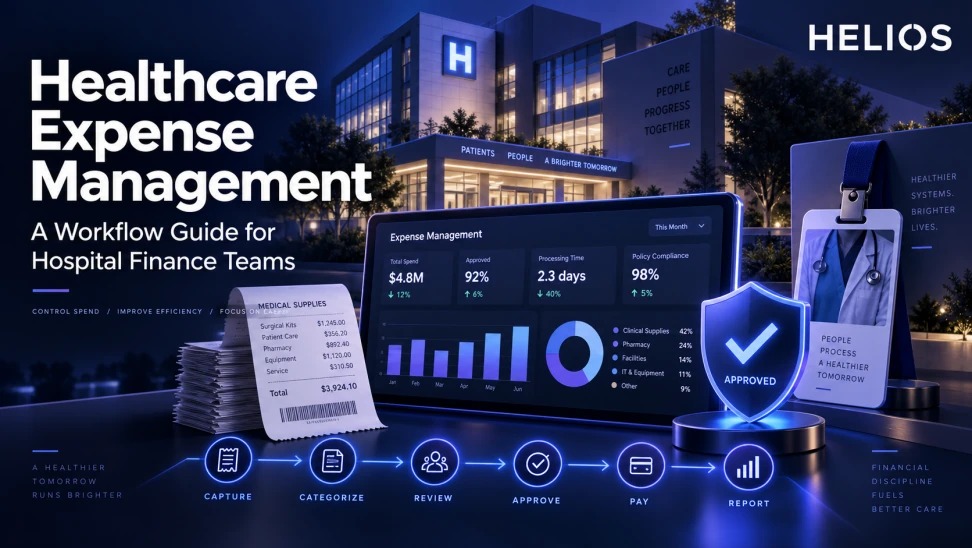
Hospital expense management connects employee purchase, mobile evidence, departmental coding, approval, finance review, and reporting.
Separate procurement from reimbursement
Define which purchases belong in sourcing, inventory, purchase orders, corporate cards, or employee reimbursement. Recurring medical supplies and contracted services generally need procurement controls; reimbursement should serve legitimate exceptions and authorized employee-paid costs.
Use category guidance that employees can understand. A familiar description such as training fee or patient transport can map behind the scenes to the required cost center, account, tax treatment, and reporting dimension.
Finance teams can evaluate controls with AI audit software for expense management.
Create an emergency purchase route
An emergency route should capture the event, patient-care or operational reason, unavailable normal option, amount, item, and accountable leader. It should be fast enough for real emergencies and specific enough to prevent routine purchases from being labeled urgent.
Review emergency expenses after the event. Repeat purchases may reveal a stocking problem, supplier gap, card-access issue, or policy limit that needs correction.
Capture receipts and protect sensitive data
Employees should photograph receipts promptly and verify merchant, date, amount, currency, and tax. The workflow should avoid collecting patient information unless required and authorized. Train users to exclude clinical details from free-text business purposes and attachments.
Set retention, access, and export rules with security, privacy, legal, tax, and audit stakeholders. Expense records should contain enough evidence for finance without becoming an uncontrolled store of health information.
Route by department, risk, and funding
Approval may depend on facility, clinical department, grant, project, amount, category, and exception status. The person confirming the business need may differ from the budget owner or finance reviewer.
Delegation and escalation matter in hospitals with shift coverage. Define who can act when an approver is unavailable, and preserve the identity, time, and reasoning behind each decision.
For document governance, review electronic accounting records for expenses.
Connect reimbursement with the ledger
After approval, payment status and accounting posting should remain linked to the expense. Finance needs a clear route for failed payments, duplicate checks, corrected cost centers, refunds, and reversals.
Employees should see whether a claim is returned, approved, scheduled, paid, or failed. Clear status reduces inquiries and helps hospital staff trust the process.
Monitor workload and policy outcomes
Track cycle time, incomplete receipts, emergency-purchase rate, returned claims, policy exceptions, duplicate alerts, accounting corrections, and employee inquiries by department and facility.
Use the findings with clinical operations and procurement. The goal is to simplify legitimate work, move repeat spend to appropriate channels, and focus review on higher-risk cases.
How Helios can support hospital finance workflows
Helios combines mobile submission, multilingual OCR, configurable policy rules, approval routing, AI copilots, accounting integration, and analytics. Hospitals can use these capabilities to build a controlled employee-expense workflow around departments, facilities, cost centers, and exceptions.
A wider product checklist appears in the expense management software guide.
- Mobile receipt capture reduces delayed or lost documentation.
- OCR structures receipt fields and supports international documents.
- Configurable policies can distinguish routine, restricted, and emergency expenses.
- Flexible workflows route claims to department, budget, and finance owners.
- Approval Copilot can support document review while preserving human accountability.
- Integration and reporting connect approved expenses with finance operations.
A practical conclusion
Hospital expense management should protect care delivery and financial accountability at the same time. Define the proper purchasing channel, create a genuine emergency route, capture only appropriate evidence, and use department-level data to improve the process.
See how Helios can support this workflow. Request a Helios demo.
FAQ about healthcare expense management
What expenses belong in a hospital reimbursement workflow?
Authorized employee-paid costs such as approved travel, training, local transport, and genuine urgent purchases may qualify; recurring supplies and services should normally use procurement.
How should hospitals handle emergency purchases?
Use a fast, documented route that records the operational reason, unavailable normal option, amount, item, and accountable approver, followed by review.
Can expense receipts contain patient information?
Expense workflows should avoid patient information unless required and authorized. Privacy and security teams should define handling, access, and retention.
Which approvals are needed for healthcare expenses?
Routes may include department managers, budget owners, grant or project owners, and finance based on amount, category, facility, funding, and exception status.
How can Helios help hospital finance teams?
Helios can support mobile capture, OCR, policy rules, approval workflows, integration, analytics, and AI-assisted review. Validate the hospital’s security and integration requirements.
Which KPIs should hospital finance monitor?
Track cycle time, missing evidence, emergency purchases, exceptions, returns, duplicates, accounting corrections, and employee questions by facility and department.