
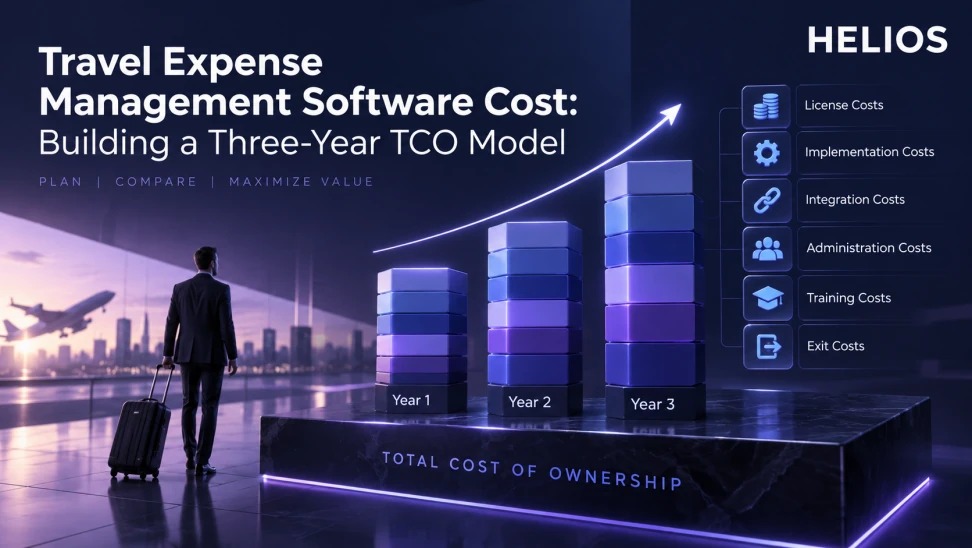
A fillable three-year total cost of ownership model for travel expense software, including licenses, implementation, integration, administration, training, and exit.
A practical framework for finance teams
A fillable three-year total cost of ownership model for travel expense software, including licenses, implementation, integration, administration, training, and exit.
This guide does not state or estimate Helios pricing. Buyers should request a scoped commercial proposal and validate taxes, currencies, payment terms, usage tiers, services, renewal, and exit conditions.
For related guidance, see expense management software guide.
The framework below connects the visible symptom or cost with the underlying workflow, required evidence, accountable owner, and a measurable decision.
Travel Expense Management Software Cost at a glance
| Cost category | Year 1 | Years 2–3 | Key driver |
| License | Subscription and minimums | Renewal and volume change | Users, reports, transactions |
| Implementation | Design, configuration, migration | Enhancements | Entities and complexity |
| Integration | Build and testing | Maintenance and changes | Systems and interfaces |
| Operations | Administration and support | Ongoing staffing | Exceptions and change |
| Exit | Usually reserve only | Export, transition, termination | Contract and data scope |
For related guidance, see AI corporate travel platform selection.
A useful operating model connects scope, evidence, ownership, and follow-through.
Set the TCO scope and scenarios
Define employee population, active users, expense reports, card transactions, countries, entities, currencies, languages, reimbursement methods, modules, environments, integrations, and service level.
Build base, growth, and stress scenarios. Record inflation, foreign-exchange, transaction growth, acquisition, and rollout timing assumptions.
For related guidance, see cloud versus on-premises expense software.
Calculate license and usage costs
Model platform fee, named or active users, reports, transactions, cards, payments, OCR volume, AI usage, modules, storage, support tier, minimum commitment, and overage where applicable.
Use the vendor’s actual unit definitions. An employee, traveler, submitter, cardholder, approver, and active user may be priced differently. Include discounts and renewal rules transparently.
Add implementation and integration
Include process design, policy configuration, entity setup, data migration, security review, identity, ERP, card, HR, travel, payment, tax, testing, project management, localization, and partner services.
Separate one-time build from recurring maintenance. Include buyer staff time, test data preparation, error remediation, and changes after ERP or organizational updates.
Model administration, training, and change
Estimate system administration, policy ownership, employee and manager training, support, communication, release testing, audit response, reporting, access review, and vendor management.
Use loaded labor rates and hours by role. Include time for new entities, turnover, policy revisions, and repeat training.
For related guidance, see ERP integration test cases.
Include risk, transition, and exit costs
Model parallel run, delayed rollout, unexpected integration work, data-quality remediation, security requirements, payment failure handling, contract minimums, and contingency.
Exit costs may include data export, archive, transition support, overlapping licenses, integration removal, employee communication, and termination fees. Confirm ownership and usable export formats.
Compare cost with measurable value
Keep benefits separate from TCO: manual hours avoided, fewer returns, faster reimbursement, better close readiness, reduced duplicate loss, and retired tools. Baseline every benefit and avoid counting cost avoidance as cash savings.
Calculate three-year TCO, cost per active user, cost per report, and cost per in-scope transaction under each scenario. Run sensitivity on the largest uncertain drivers.
How Helios supports this workflow
Helios can connect mobile expense capture, multilingual OCR, configurable policy controls, role-based approvals, accounting preparation, integration, multidimensional reporting, and confirmed Spark AI conversational scenarios. Customer outcomes, prices, automated root-cause findings, predictive models, and capabilities outside the confirmed product scope should not be assumed.
For related guidance, see travel expense policy template.
- Provide a global expense workflow that can be scoped by users, entities, and countries.
- Support mobile capture, OCR, policies, approvals, accounting preparation, integration, and reporting.
- Provide implementation inputs for configuration and finance-system testing.
- Support measurable workflow outcomes used in a separate business case.
- Allow buyers to validate required modules, volumes, support, and integration scope.
- Require an actual Helios proposal for pricing and contract terms.
A practical conclusion
Define the work before selecting the feature. Preserve evidence and ownership, test representative cases, and measure the full operational outcome rather than a single attractive number.
See how Helios can support this workflow. Request a Helios demo.
FAQ
What is travel expense software TCO?
It is the full three-year cost of licenses, implementation, integration, administration, training, operations, risk, and exit.
Which license costs should be modeled?
Model platform, user, report, transaction, card, payment, OCR, AI, module, storage, support, minimum, and overage charges as applicable.
Which internal costs are often missed?
Buyer project time, data cleanup, testing, administration, policy ownership, training, support, release testing, and vendor management.
How should integrations be costed?
Separate initial design and build from testing, error handling, maintenance, changes, monitoring, and eventual removal.
How should vendors be compared?
Use the same scope, assumptions, time horizon, unit definitions, scenario, taxes, currency basis, and contract treatment.
What does Helios cost?
This article does not state Helios pricing. Request a scoped proposal based on users, volumes, countries, modules, integrations, and services.