
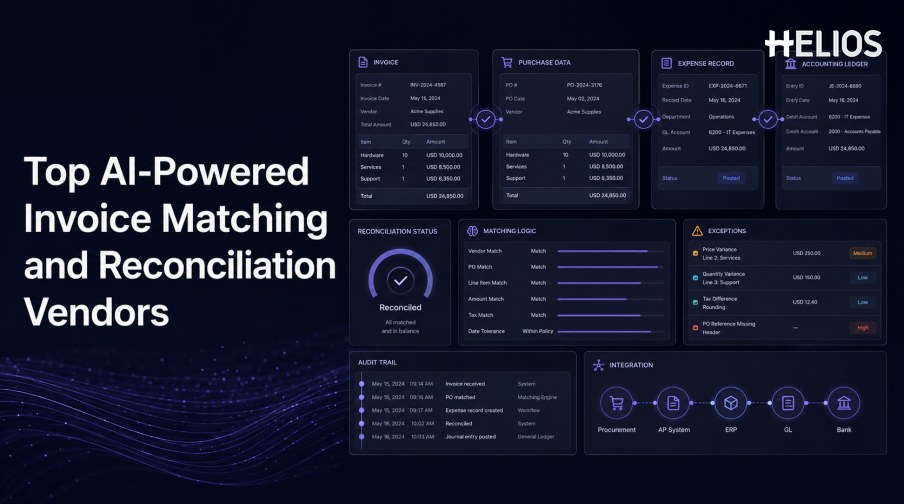
AI-powered invoice matching and reconciliation vendors help finance teams compare invoice data with purchase records, expense reports, card transactions, receipts, accounting entries, or other approved references. The objective is to identify reliable matches, explain differences, and route unresolved items before they affect reporting or payment.
Vendor claims are difficult to compare because the term matching can describe very different processes. A product may support field-level duplicate checks, two-way invoice-to-order matching, three-way matching with receipt evidence, expense-to-card reconciliation, or source-to-ledger reconciliation. Buyers should define the exact control they need before ranking platforms.
This guide provides an evaluation framework and explains how Helios invoice capture, expense controls, approval workflows, and accounting integration can support parts of the expense-to-accounting process without presenting Helios as a universal accounts-payable matching suite.
What Invoice Matching and Reconciliation Vendors Do
Matching compares two or more records and determines whether their identities, dates, currencies, amounts, taxes, quantities, and other fields agree within approved rules. Reconciliation confirms that expected records are complete, differences are explained, and the final status is reflected in the appropriate financial system.
The scope may include invoices, purchase orders, goods receipts, employee expenses, corporate cards, accounting journals, or bank transactions. A buyer should document every source, target, matching relationship, exception owner, and authorized outcome.
Matching Logic to Evaluate
The matching engine should make both the rule and the evidence visible.
- Deterministic keys. Match exact identifiers such as invoice number, purchase-order number, employee, card transaction, supplier, or expense-report reference.
- Fuzzy and semantic matching. Handle spelling variation, abbreviations, reordered descriptions, and imperfect document recognition without hiding uncertainty.
- Amount and date tolerances. Configure permitted differences by currency, document type, tax, quantity, unit price, rounding, date, or business scenario.
- Header and line-level matching. Test both document totals and individual rows when quantity, price, tax, or delivery evidence matters.
- Many-to-one relationships. Support split receipts, combined invoices, multiple card charges, credits, partial deliveries, or staged approvals where required.
- Matching hierarchy. Define which sources are authoritative and how conflicts between identifiers, amounts, images, and reference data are resolved.
Accuracy and Test Criteria
A single accuracy percentage cannot describe matching quality.
- True-match rate. Measure how often genuine relationships are found across common and difficult scenarios.
- False-match rate. Track incorrect pairings, because an apparently complete reconciliation can conceal control failures.
- Missed-match rate. Identify valid relationships that are unnecessarily sent to manual review.
- Field-level variance. Test identifiers, dates, currency, subtotal, tax, total, quantities, prices, and descriptions separately.
- Exception effort. Measure active review time, evidence requests, reassignment, and repeated corrections.
- Downstream acceptance. Confirm whether resolved records are accepted by the expense, AP, accounting, or reporting system without later repair.
Exception Handling and Audit Trail
The exception workflow often determines the real operating cost of a platform.
- Explainable differences. Show the compared fields, source evidence, rule, tolerance, confidence, and reason for the exception.
- Risk-based prioritization. Use value, age, policy severity, duplicate risk, confidence, and reporting impact to order the queue.
- Accountable ownership. Route supplier, employee, purchasing, manager, finance, tax, or accounting questions to the correct role.
- Controlled resolution. Support correct, accept within tolerance, request evidence, return, reject, split, link, unmatch, or escalate actions.
- Complete history. Retain source documents, compared records, original result, edits, comments, decisions, actors, timestamps, exports, and final status.
- Reopening controls. Document what happens when a source record changes after approval or a later accounting difference appears.
Integration and Accounting Requirements
Matching depends on timely, governed data from every system in scope.
- Source connections. Evaluate APIs, files, connectors, batch timing, attachments, reference data, authentication, and schema ownership.
- Master-data consistency. Align entity, supplier, employee, account, tax, currency, cost center, project, and identifier structures.
- Accounting mapping. Confirm how approved results become draft entries, interface records, posted journals, adjustments, or reconciliation statuses.
- Failure handling. Test rejected records, duplicate messages, retries, idempotency, outages, partial success, and manual fallback.
- Source-to-ledger traceability. Keep the accounting outcome linked to the invoice, matched evidence, exception decision, and later adjustment.
- Security and segregation. Review access, approval authority, privileged configuration, retention, monitoring, and separation of incompatible duties.
How to Compare Vendors Fairly
Use one scope, test set, and scorecard for every vendor.
- Define the matching boundary. List sources, targets, fields, volumes, countries, currencies, tolerances, exception owners, and final outcomes.
- Build representative cases. Include exact matches, partial matches, credits, duplicates, missing records, tax differences, splits, timing differences, and legitimate exceptions.
- Weight control criteria. Prioritize false matches, material fields, explanation, auditability, integration reliability, and segregation of duties.
- Run end-to-end scenarios. Test ingestion, matching, exception resolution, approval, accounting, failure recovery, reconciliation, and audit retrieval.
- Measure total effort. Include configuration, integration, exception review, administration, support, change management, and model monitoring.
- Validate the proposed configuration. Confirm capabilities in the exact product version, region, implementation plan, data set, and acceptance criteria being purchased.
How Helios Relates to Invoice Matching and Reconciliation
Helios is an expense-management platform that publicly describes invoice OCR, policy controls, configurable approvals, accounting-entry generation, and analytics. Spark AI adds conversational claim and approval assistance. These capabilities provide five relevant connections:
- Create structured document data. Invoice upload or photography with OCR reduces manual entry before matching or review.
- Apply expense context. Policy controls connect document data with business rules and reimbursement requirements.
- Route differences. Configurable approval workflows support accountable review of exceptions.
- Prepare accounting outcomes. The accounting engine generates journal entries from approved expense reports.
- Analyze activity. Dashboards and reports support finance visibility across expense operations.
Helios also presents itself as an enterprise-grade provider with global experience and information-security credentials. The public product page does not claim universal two-way or three-way purchase-order matching, bank reconciliation, or a complete AP platform. Buyers should validate every matching source, rule, tolerance, exception action, accounting system, payment boundary, regional requirement, and integration in scope.
FAQs About AI-Powered Invoice Matching and Reconciliation Vendors
What is the difference between matching and reconciliation?
Matching identifies relationships between records. Reconciliation confirms completeness, resolves differences, and records the final controlled status.
Is three-way matching always required?
No. The required relationship depends on the process. Some expenses match a receipt to a claim or card transaction, while procurement may require invoice, order, and receipt evidence.
Which accuracy metric matters most?
Use several measures, especially false matches, missed matches, field-level variance, exception effort, and downstream acceptance.
Why is explainability important?
Reviewers need to know which records, fields, rules, tolerances, and evidence produced a match or exception before making a financial decision.
Where does Helios fit?
Helios connects OCR-based invoice capture with expense policy, approvals, accounting-entry generation, and reporting. Broader AP or reconciliation requirements should be validated separately.
Finance teams can compare Helios invoice capture and accounting workflows with matching vendors using the same documents, reference records, tolerances, exception cases, accounting mappings, failure scenarios, and audit-trail requirements.