
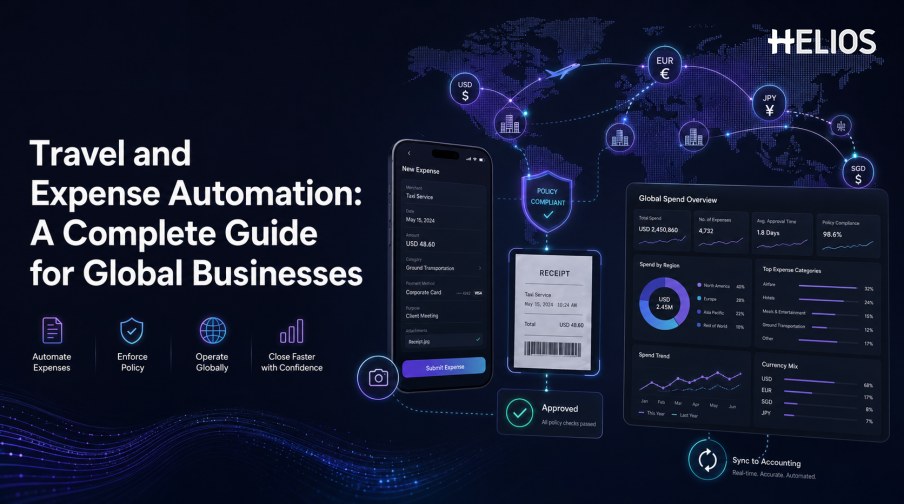
Travel and expense management automation connects the activities before, during, and after a business trip with company policy, approval, reimbursement, accounting, and management reporting. For global businesses, the process also needs to handle multiple entities, currencies, languages, tax requirements, and local operating practices.
The goal is not merely to digitize an expense form. A strong design captures evidence close to the transaction, reduces manual entry, applies the correct policy, routes approval by organizational context, records finance decisions, and produces consistent accounting and reporting data across regions.
This guide covers the end-to-end process, core capabilities, implementation value, selection criteria, and how Helios and Spark AI support enterprise T&E workflows.
What Is Travel and Expense Management Automation?
Travel and expense automation uses connected workflows to manage travel requests, employee spending, receipt capture, expense reports, policy checks, approvals, reimbursement, accounting preparation, and analysis. The process may include travel services, but its financial purpose is to control and account for business travel spend.
Global automation must combine enterprise consistency with local configuration. Central finance may define common categories, approval principles, and reporting dimensions, while local entities apply their own currencies, tax rules, receipt requirements, thresholds, and payment processes.
The End-to-End T&E Automation Process
A connected workflow reduces handoffs and keeps each decision traceable.
- Request and authorize travel. Capture purpose, itinerary, estimated cost, entity, project, and required pre-trip approval.
- Record business spend. Receive card transactions and allow employees to photograph or upload receipts close to purchase.
- Create the expense report. Extract receipt fields, suggest categories, associate trip context, and request missing information.
- Apply policy and validation. Check limits, dates, classes of service, categories, currencies, duplicates, attendees, and evidence.
- Route approval. Use amount, entity, role, department, cost center, project, and exception type.
- Perform finance review. Verify tax, currency, accounting dimensions, policy exceptions, and payment readiness.
- Prepare reimbursement and accounting. Approve the payable amount and create mapped financial records for downstream systems.
- Report and improve. Analyze spend, policy exceptions, cycle time, regional trends, and process bottlenecks.
Core Capabilities for Global Businesses
The platform should support both local execution and centralized financial control.
- Multi-entity configuration. Separate legal entities, business units, approval authorities, accounting mappings, and settlement processes.
- Multi-currency processing. Retain transaction, card, reimbursement, and accounting currencies with governed exchange-rate logic.
- Language and localization. Support employee interfaces, document recognition, dates, decimals, currencies, and local receipt formats.
- Unified policy framework. Maintain global principles with controlled local limits, categories, tax rules, and evidence requirements.
- Flexible approvals. Route by entity, role, department, cost center, project, amount, and exception.
- Accounting and tax dimensions. Map account, tax code, entity, cost center, project, intercompany context, and other financial fields.
- Consolidated analytics. Compare spend and process performance across countries while retaining local detail.
Implementation Value
Value should be measured across employee experience, control quality, and finance operations.
- Less employee administration. Mobile capture and prefilled fields reduce post-trip receipt sorting and rekeying.
- Earlier policy intervention. Automated rules identify missing evidence and noncompliant spending before reimbursement.
- Faster approval cycles. Conditional routing sends each report to the correct role with relevant evidence.
- More focused finance review. Reviewers spend more time on exceptions and less time checking complete routine fields.
- Consistent accounting data. Approved reports use governed dimensions and reduce downstream manual entry.
- Better global visibility. Central teams can analyze spend, exceptions, cycle time, entities, currencies, and trends.
How to Implement Travel and Expense Automation
A phased implementation protects local requirements while establishing common governance.
- Map the current process. Document systems, entities, policies, currencies, languages, roles, pain points, and data owners.
- Design the global model. Define common categories, approval principles, reporting dimensions, controls, and exception taxonomy.
- Configure local requirements. Add country-specific limits, tax, receipt, currency, reimbursement, retention, and payment rules.
- Build integrations. Connect identity, card, travel, HR, accounting, reimbursement, reporting, and reference-data sources as required.
- Pilot representative regions. Test high-volume, complex, and multilingual scenarios instead of choosing only the easiest country.
- Train by role. Give employees, managers, finance reviewers, administrators, and support teams task-specific guidance.
- Monitor and improve. Review adoption, correction, exception, approval, reimbursement, integration, and accounting metrics.
Selection Criteria
Evaluate the complete operating model, not only the employee interface.
- Functional coverage. Confirm request, capture, claim, policy, approval, reimbursement, accounting, reporting, and administration requirements.
- Global fit. Test entities, countries, currencies, languages, tax, retention, time zones, and local support.
- Configuration depth. Determine what local teams can configure without fragmenting the global control model.
- Integration reliability. Test data timing, mapping, security, retries, reconciliation, monitoring, and failure recovery.
- Security and governance. Review access, segregation, encryption, data location, retention, audit history, and change control.
- User adoption. Test real mobile capture, difficult receipts, frequent travelers, managers, and finance review scenarios.
- Measured outcomes. Define cycle time, touch time, compliance, exception age, reimbursement time, accounting rejection, and reporting quality targets.
How Helios Supports Global Travel and Expense Automation
Helios publicly presents an enterprise expense platform with mobile travel and expense activity, AI-Powered Receipt Capture, automated policy control, flexible approvals, accounting-entry generation, and analytics. Spark AI adds conversational Travel, Claim, Approval, and Service Copilots. Together, these capabilities address five global T&E needs:
- Mobile travel and expense experience. Employees can manage business-trip tasks and submit expense evidence from a mobile device.
- Faster claim creation. OCR auto-fills document details, while Claim Copilot supports conversational expense submission.
- Consistent policy enforcement. Automated controls apply company spending rules, and Service Copilot can answer policy questions.
- Configurable global routing. Approval workflows can use department, role, cost center, and organizational conditions.
- Finance integration and visibility. Approved reports can generate journal entries, while dashboards provide multi-dimensional analysis.
Helios also presents itself as an enterprise-grade provider with offices across several Asia-Pacific locations and information-security credentials. Global buyers should still validate exact country coverage, currencies, languages, tax logic, local reimbursement and payment methods, travel-content scope, accounting connectors, data residency, support model, and implementation responsibilities.
FAQs About Travel and Expense Management Automation
What is travel and expense automation?
It connects travel requests and business spending with receipt capture, expense reports, policy, approval, reimbursement, accounting, and reporting workflows.
How is global T&E automation different?
It must support multiple entities, currencies, languages, tax rules, local policies, accounting structures, and centralized reporting.
Does T&E automation eliminate finance review?
No. It reduces routine checking and directs attention to exceptions, while finance retains authority over material, tax, accounting, and payment decisions.
Which implementation metrics matter?
Track employee touch time, correction rate, policy exceptions, approval time, reimbursement time, integration failures, accounting rejections, and reporting completeness.
How does Helios support global T&E?
Helios connects mobile expense activity, OCR capture, policy, approvals, journal-entry generation, reporting, and Spark AI copilots. Exact regional scope should be validated for the rollout.
Global organizations can evaluate Helios travel and expense management with representative entities, currencies, languages, local policies, receipts, approval routes, accounting mappings, integration failures, and reporting requirements.