
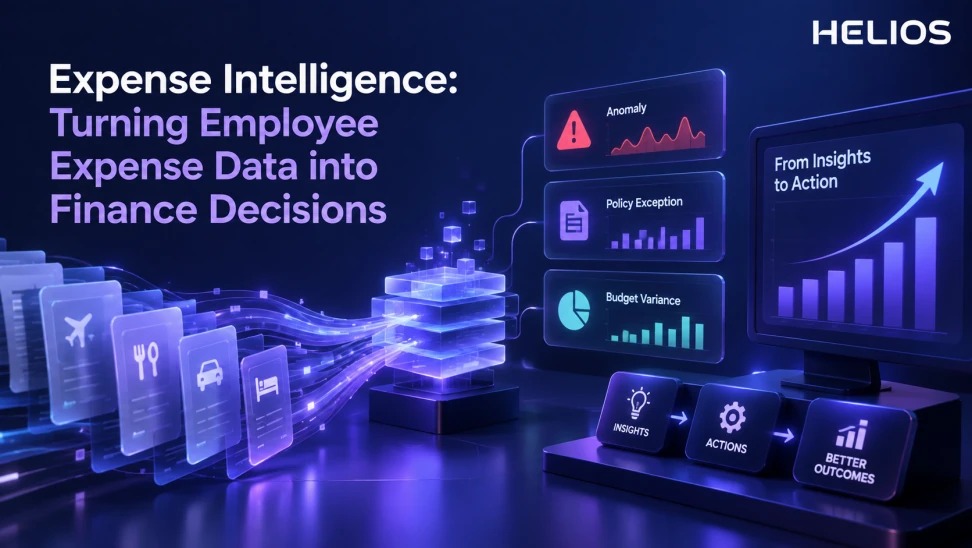
A practical expense intelligence model connecting governed data, defined metrics, and accountable action across anomalies, policy exceptions, and budget variance.
A practical framework for employee expenses
A practical expense intelligence model connecting governed data, defined metrics, and accountable action across anomalies, policy exceptions, and budget variance.
Expense intelligence is an operating discipline rather than a promise that software automatically finds every risk or makes financial decisions. Specific predictive algorithms, autonomous actions, and integration coverage must be validated.
For related guidance, see automated expense tracking.
The strongest workflow asks for the minimum information needed to understand the business decision, applies the right reviewer, and preserves enough evidence for accounting, compliance, and later analysis.
Expense Intelligence at a glance
| Layer | Required inputs | Output | Control |
| Data | Claims, receipts, cards, policy, approvals | Trusted expense record | Reconciliation |
| Metric | Definition, denominator, baseline | Comparable signal | Versioned logic |
| Insight | Context and materiality | Decision hypothesis | Human review |
| Action | Owner, workflow, due date | Policy or process change | Authority |
| Outcome | Cost, control, time, experience | Measured result | Follow-up |
For related guidance, see AI copilots for CFO teams.
A clear operating model connects context, evidence, ownership, and action.
Build the governed data layer
Connect claims, card transactions, receipts, advances, reimbursements, approvals, policy results, accounting status, entity, category, department, project, employee, merchant, currency, and time.
Use stable identifiers, reconciled channels, controlled mappings, access rules, and documented date and currency bases. Poorly joined data creates confident but false insight.
For related guidance, see expense automation reporting.
Define the metric layer
A metric needs a business question, formula, numerator, denominator, population, period, baseline, owner, threshold, and limitation. Keep definitions versioned when policy or taxonomy changes.
Pair value with transaction count and population. Segment before comparing teams, countries, or categories with different operating conditions.
Use anomalies as review signals
An anomaly may be unusual value, frequency, merchant, timing, route, category, sequence, or combination. It indicates difference, not wrongdoing.
Set a review priority based on materiality and risk. Record the reviewer result, explanation, false-positive reason, and corrective action to improve future analysis.
Turn policy exceptions into policy decisions
Group exceptions by rule, category, entity, employee population, reason, approver, amount, and outcome. Distinguish justified business exceptions from incomplete submissions and confirmed noncompliance.
A recurring justified exception may mean a threshold is outdated. Repeated missing evidence may require clearer prompts, training, or a redesigned workflow.
For related guidance, see expense categories and GL accounts.
Explain budget variance
Compare consistent actual, commitment, and budget definitions. Decompose variance into volume, price, mix, timing, currency, classification, and scope changes.
Assign the variance to the owner who can explain and act. Avoid treating every unfavorable variance as waste or every favorable variance as permanent savings.
Close the insight-to-action loop
For each insight record owner, decision, action, due date, expected outcome, safeguard, and follow-up measure. Monitor whether cost, compliance, processing time, employee burden, or business performance changed.
Use human review for novel, uncertain, sensitive, or high-impact cases. Preserve evidence and make automated assistance observable and correctable.
How Helios supports this workflow
Helios can connect mobile expense capture, multilingual OCR, configurable policy controls, role-based approvals, accounting preparation, integration, and multidimensional reporting. Spark AI copilots can assist employees and reviewers in confirmed conversational and policy-review scenarios. Exact algorithms, automated decisions, integrations, and local requirements should be validated during implementation.
For related guidance, see AI finance agent limitations.
- Create structured data through mobile capture and OCR.
- Apply policy rules and role-based approvals.
- Report expenses across entity, category, department, project, user, currency, and time.
- Use Spark AI in confirmed conversational and policy-review scenarios.
- Connect expense and accounting status through integrations.
- Support finance-owned anomaly, exception, variance, and outcome analysis.
A practical conclusion
Clear context makes employee expense decisions faster and easier to defend. Define the required facts, assign the correct owner, preserve exceptions, and use the resulting data to improve policy and operations.
See how Helios can support this workflow. Request a Helios demo.
FAQ
What is expense intelligence?
It is the governed use of employee expense data, metrics, analysis, and workflows to support finance decisions and measured action.
Which data does it require?
Claims, receipts, cards, approvals, policy results, reimbursements, accounting status, organizational dimensions, currencies, and dates.
Is an anomaly evidence of fraud?
No. It is a review signal that requires context, evidence, and an accountable decision.
How do exceptions improve policy?
Patterns reveal outdated thresholds, unclear guidance, missing fields, workflow gaps, or repeated noncompliance.
How should budget variance be analyzed?
Use consistent definitions and separate volume, price, mix, timing, currency, classification, and scope effects.
How does Helios support expense intelligence?
Helios can provide structured workflow data, controls, integrations, reporting, and confirmed AI assistance; finance owns decisions and outcomes.