
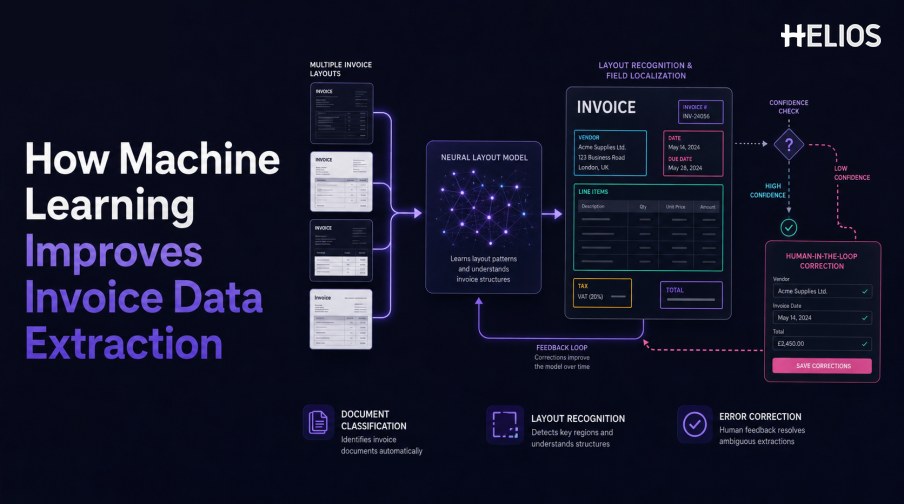
Invoice data extraction machine learning systems learn patterns across document layouts instead of relying only on fixed coordinates. They can identify invoice regions, classify tokens into fields, reconstruct tables, and help recognize new supplier formats with less manual template maintenance.
Machine learning does not make invoice data automatically trustworthy. Its output still needs source evidence, confidence handling, format and arithmetic checks, reference data, human correction, and downstream controls. The value comes from combining flexible recognition with accountable financial workflows.
This guide explains the main machine-learning tasks, training and feedback process, benefits, limitations, and the relevance of Helios OCR-based invoice capture.
Where Machine Learning Enters Invoice Extraction
OCR creates text and coordinates. Machine learning can then determine document type, detect regions, classify tokens, link labels with values, reconstruct line-item tables, and estimate confidence. Some models operate directly on images and text together.
A production pipeline may combine learned models with templates, deterministic rules, supplier or entity reference data, and human review. The combination is often more robust than one method alone.
Machine-Learning Tasks That Improve Extraction
Different model tasks address different parts of the document.
- Document classification. Distinguish invoices, receipts, credit notes, supporting records, and unrelated documents.
- Layout segmentation. Detect headers, address blocks, tables, totals, footers, stamps, and other regions.
- Token classification. Label recognized text as supplier, invoice number, date, currency, subtotal, tax, total, or another field.
- Key-value linking. Connect a label with its nearby value even when the page arrangement varies.
- Table extraction. Identify rows and columns and associate descriptions, quantities, prices, tax, and amounts.
- Confidence estimation. Identify uncertain predictions that should be checked by a person or additional rule.
Training, Validation, and Human Feedback
Model quality depends on representative data and disciplined change management.
- Define the schema. Specify each required field, normalization rule, table structure, and acceptable missing value.
- Label representative documents. Include layouts, languages, currencies, image quality, taxes, pages, and exceptions found in production.
- Separate evaluation data. Use unseen documents to test whether the model generalizes instead of memorizing suppliers.
- Measure critical fields. Report exact-match results for identifiers, dates, currency, totals, tax, and line items separately.
- Capture corrections. Store original prediction, evidence, correction, reason, user, and timestamp.
- Retrain carefully. Review correction quality, version models, compare against a fixed test set, and monitor after release.
Benefits for Finance Teams
Well-governed models can reduce repetitive work and improve consistency.
- Fewer supplier templates. Layout-aware models can generalize across variations instead of requiring fixed coordinates for every format.
- Faster field localization. The system identifies likely values and source regions before a user reviews the document.
- Better document routing. Classification sends each file to the correct extraction and workflow path.
- Focused corrections. Confidence and validation direct attention to uncertain or material fields rather than every value.
- More consistent normalization. Dates, currencies, decimals, and identifiers enter governed structures.
- Scalable measurement. Finance can track quality by supplier, layout, field, language, and exception type.
Challenges and Control Requirements
Machine learning introduces risks that should be designed into the operating model.
- Data drift. New layouts, tax rules, languages, document quality, or supplier behavior can weaken performance.
- Rare-field performance. A strong average can conceal poor results for tax, payment terms, credits, or uncommon line-item structures.
- Label quality. Inconsistent training or correction labels can teach the model the wrong behavior.
- Explainability. Reviewers need the source region, candidate value, confidence, validation result, and correction history.
- Automation bias. People may accept plausible values too quickly; material fields need explicit checks and thresholds.
- Privacy and security. Invoices may contain personal, tax, supplier, banking, or commercial information requiring protection.
A Controlled Machine-Learning Extraction Workflow
A practical implementation keeps model output inside financial controls.
- Preserve the original document. Store the source, channel, timestamp, pages, and relevant metadata.
- Run OCR and layout analysis. Recognize text and visual regions while retaining coordinates.
- Predict structured fields. Classify values and reconstruct tables according to the governed schema.
- Apply deterministic checks. Validate required fields, formats, arithmetic, duplicates, and approved reference data.
- Route uncertain cases. Send missing, conflicting, low-confidence, or unusual values to accountable reviewers.
- Approve and map. Apply policy, workflow, entity, account, tax, cost center, and project controls.
- Export and monitor. Track downstream acceptance, corrections, drift, failures, and audit retrieval.
How Helios Supports Controlled Invoice Extraction
Helios publicly describes OCR that fills details from a photographed or uploaded invoice. The extracted expense information can move through policy controls, flexible approvals, accounting-entry generation, and reporting. Spark AI adds AI-assisted claim and approval interactions. These capabilities support five parts of a controlled workflow:
- Preserve invoice evidence. Users capture or upload the source document.
- Reduce initial entry. OCR fills relevant information for confirmation.
- Review exceptions. Users, policy checks, and approvals address uncertain or noncompliant cases.
- Create accountable outcomes. Approved expense data can generate journal entries through the accounting engine.
- Monitor the process. Reporting supports visibility into financial operations.
Helios also presents itself as an enterprise-grade provider with global experience and information-security credentials. Helios publicly emphasizes OCR rather than a detailed machine-learning architecture. Buyers should validate model methods, training and correction use, field and line-item coverage, confidence, drift monitoring, privacy, tax logic, accounting mappings, and integration controls.
FAQs About Invoice Data Extraction Machine Learning
How does machine learning improve invoice extraction?
It can recognize layouts, classify document regions and text, link labels with values, reconstruct tables, and identify uncertain predictions across varied formats.
Does machine learning eliminate templates and rules?
Not always. Templates can help stable layouts, while rules provide deterministic format, arithmetic, reference-data, and policy checks.
What data is needed to train a model?
Use accurately labeled, representative documents covering layouts, languages, currencies, image quality, taxes, line items, and legitimate exceptions.
How should model performance be monitored?
Track field-level accuracy, corrections, document success, exception rate, downstream rejection, and performance by layout or segment.
Does Helios disclose its machine-learning architecture?
The public product page describes OCR-based invoice capture and auto-fill. Organizations should validate the detailed model architecture during evaluation.
Finance teams can test Helios invoice OCR and expense controls using unseen layouts, critical fields, corrections, policy exceptions, approval routes, accounting mappings, downstream failures, and production monitoring criteria.