
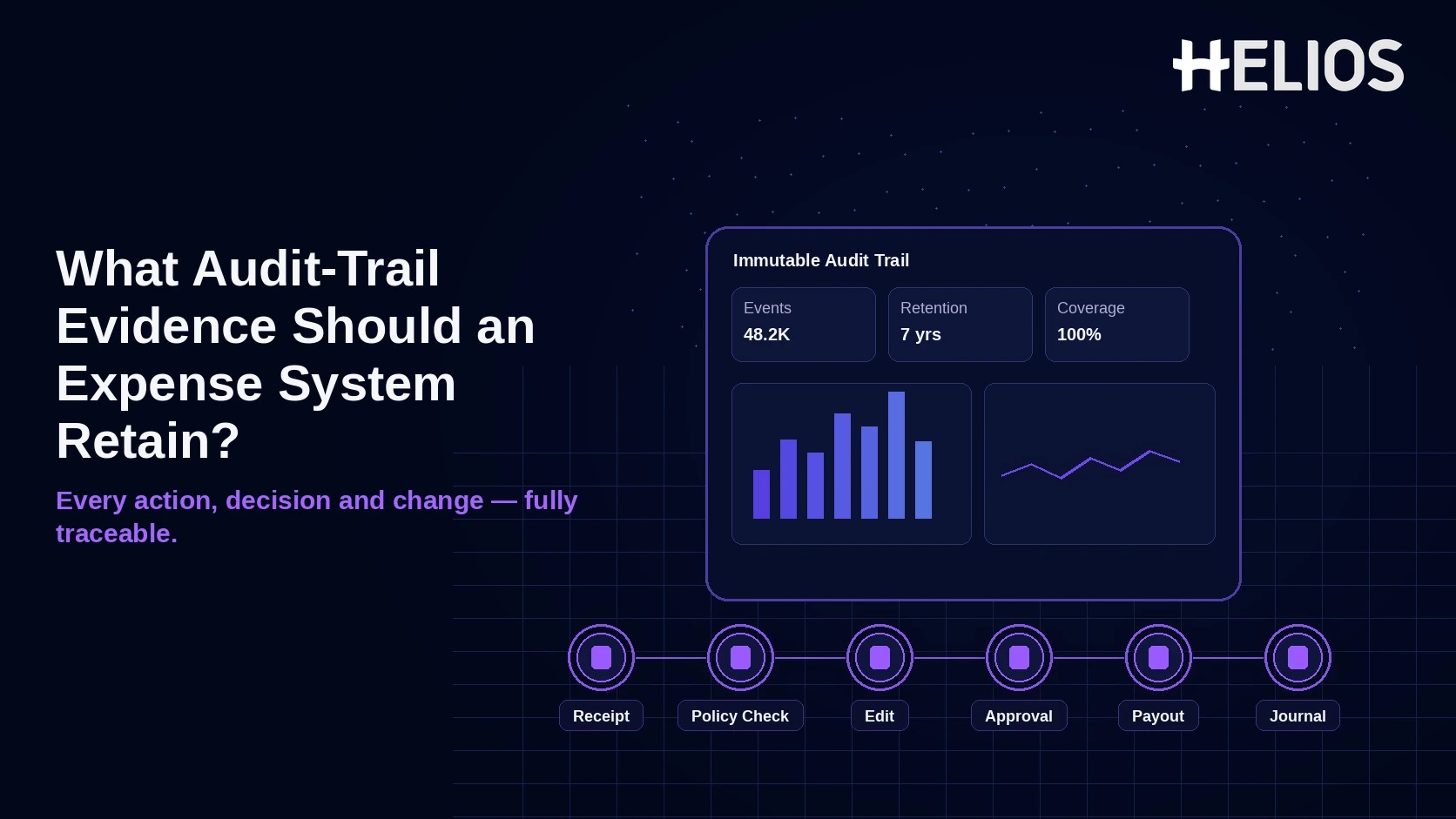
A strong expense audit trail is not simply a folder of receipts. It is a linked, time-stamped record of what happened to a transaction, what evidence supported it, which rules were applied, who approved or changed it, how it was paid, and where it ultimately posted in the ledger. That chain matters to both internal and external auditors because it turns a financial result back into verifiable evidence.
The practical design test is simple: could a reviewer who did not participate in the process reconstruct the expense without relying on someone’s memory? PCAOB audit-documentation requirements use a similar concept: documentation should be detailed enough for an experienced auditor to understand the work performed, evidence obtained, conclusions reached, and who performed and reviewed the work. Internal audit standards likewise emphasize information that is relevant, reliable, and sufficient.
External reference: PCAOB AS 1215 — Audit Documentation
External reference: The IIA Global Internal Audit Standards
What Evidence Should an Expense System Retain?
| Evidence layer | What to retain | Why auditors need it |
| Source evidence | Original receipt/invoice image or file; booking/invoice reference; vendor/merchant; transaction date; amount; currency; tax fields; attachment hash or source metadata. | Substantiates that the transaction occurred and preserves the original evidence auditors may inspect. |
| Claim data | Expense report/line ID; employee; entity; category; business purpose; attendees; department/cost center; project/client; payment method; submission date. | Explains who incurred the cost, why it was business-related, and how it was classified. |
| Policy & control evidence | Policy/version in force; rule evaluated; pass/fail result; limit; required evidence; exception reason; automated or manual control outcome. | Shows which control was expected to operate and what the system decided at the time. |
| Approval history | Approver identity/role; sequence; timestamp; decision; comments; delegation/substitution; escalation; rejected/reopened state. | Supports authorization, accountability, and segregation-of-duties testing. |
| Change history | Field changed; old value; new value; user/system actor; timestamp; reason; before/after attachments where relevant. | Prevents silent post-approval alteration and lets auditors reconstruct the record actually approved. |
| Payment & bank evidence | Payee; payment method; payout/payment ID; amount/currency; payment date; bank/provider reference; confirmed/failed/returned status; fees/FX if relevant. | Connects the approved liability to the actual cash movement and exceptions. |
| Accounting & ERP posting | Journal/document ID; entity/ledger; GL; tax code; cost center/project/client; posting date/period; debit/credit; ERP status; reversal or correction link. | Links the expense to the books, cut-off, tax treatment, and financial statement population. |
| System & master-data context | Employee/entity/master-data IDs; role/access changes; policy configuration changes; integration status; key admin events. | Provides context for control design, access, routing, and the reference data used when the transaction was processed. |
Internal Audit and External Audit Need the Same Chain—But Ask Different Questions
| Audit perspective | Typical question | Evidence that helps |
| Internal audit | Did the control operate as designed, and were exceptions handled consistently? | Policy version, rule result, approval path, overrides, admin/config changes, access logs, exception aging, corrective action. |
| External financial audit | Is the expense valid, complete, accurately measured, correctly classified, in the right period, and reconciled to the books? | Source documents, approved amount, transaction date, entity/GL/tax coding, payment/bank reference, journal ID, cut-off and reconciliation. |
| Tax/VAT/GST review | Is the tax evidence valid and is recovery or non-recovery supported? | Original tax invoice/receipt, tax fields, supplier details, place/date of supply, tax code, recoverability decision, later credit note/refund. |
| IT/control audit | Can unauthorized or undocumented changes alter the financial trail? | User roles, privileged access, configuration history, interface logs, failed integrations, audit-log retention and export controls. |
An expense platform should therefore preserve both transaction evidence and control evidence. A receipt alone cannot prove the expense was approved correctly; an approval timestamp alone cannot prove the amount posted to the ledger matches what was approved.
The Audit Trail Should Be Event-Based, Not Just a Final Snapshot
Auditors often need to understand the sequence of events, especially when a report was edited, reopened, returned, paid again, refunded, or reversed. A final-state record that overwrites prior values is much weaker than an event history.
| Event | Minimum event record |
| Receipt captured | Source channel, original file, capture timestamp, OCR-extracted values, user/device or integration source where appropriate. |
| Claim created/submitted | Report/line ID, employee, entity, amount/currency, business purpose, coding dimensions, submission timestamp. |
| Policy checked | Policy/version, rule ID/name, fields evaluated, outcome, exception reason, system/manual actor. |
| Approval action | Approver, role, decision, timestamp, comments, delegation/escalation, sequence number. |
| Record edited | Field, previous value, new value, actor, timestamp, reason, whether re-approval was triggered. |
| Payment initiated/settled | Payment ID, method, amount, currency, provider/bank reference, status timestamps, return/failure reason if any. |
| Journal posted | ERP document/journal ID, posting period/date, entity/ledger, accounts/dimensions, integration status. |
| Refund/reversal/correction | Link to original transaction, amount/currency, reason, approving actor, replacement or reversal journal/payment reference. |
Keep the Evidence That Explains the Decision, Not Only the Outcome
For automated controls, “approved” or “policy passed” is not enough. Auditors need enough context to understand why the control produced that result. Expense systems should retain the policy or rule version in force, the key inputs evaluated, the result, and any later override. If a manager manually approves an exception, the reason and approval authority should remain linked to the expense.
- Preserve policy versioning so later policy changes do not rewrite the historical decision context.
- Record automated checks and human overrides separately; an override should not erase the original exception.
- Capture rejected, reopened, delegated, escalated, and resubmitted states—not only the final approver.
- If approval routing depends on entity, department, cost center, amount, or role, retain the routing inputs used at that moment.
Link the Approved Expense to Payment, Bank Evidence, and the Ledger
True auditability continues after approval. The expense report should connect to the employee payable or payment request, the payout/payment reference, the bank or provider confirmation, and the journal or ERP document. This matters when auditors test existence, duplicate payment risk, cut-off, or whether a failed/returned payment was subsequently reissued.
- Approval record. Keep the approved amount, coding, tax treatment, and final approval timestamp as the authorized state.
- Payment record. Link the payment or payout request to the same report/employee payable with a unique payment ID and status history.
- Cash confirmation. Where the payment rail provides it, retain bank/provider settlement or return references rather than assuming “sent” means “received.”
- Accounting posting. Link the expense to the ERP journal/document ID, ledger/entity, accounts, dimensions, and posting period.
- Closure. A record is truly closed only when exceptions, returns, corrections, and reversals are resolved and the accounting trail reconciles.
Retention: Build a Policy Matrix, Not a Universal “Seven-Year Rule”
A common mistake is to copy an auditor workpaper retention rule directly into the company expense system. PCAOB AS 1215 requires registered audit firms to retain their audit documentation for seven years, but that does not automatically mean every company expense record in every country has the same legal retention period. Company records may be governed by local tax, corporate, payroll, privacy, litigation-hold, and sector requirements.
A global finance team should therefore maintain a retention matrix by record type and jurisdiction. The system should support the longest applicable requirement for each population, preserve legal holds, and prevent ordinary deletion while a hold is active.
| Retention design question | Recommended control |
| What is the record type? | Separate source receipts/invoices, expense reports, payment records, journals, tax evidence, policy versions, and system/admin logs. |
| Which legal entity/jurisdiction owns it? | Apply entity- and country-specific retention rules rather than one global guess. |
| Is the record subject to audit, tax review, investigation, or litigation hold? | Suspend deletion and retain related documents, events, and exports until release is authorized. |
| Can the system prove later changes? | Use version/event history and controls that prevent ordinary users from rewriting historical audit records. |
| Can evidence be exported? | Provide searchable, readable exports with attachments and IDs intact; test that exports remain understandable outside the application. |
Audit-Readiness Controls Finance Should Test
- Unique IDs across claim, payment, bank/settlement, and journal records so evidence can be traced without name-based guessing.
- Immutable or tamper-evident event history for critical approval, change, payment, and posting actions—or equivalent controls that clearly reveal modifications.
- Role-based access and segregation of duties for submit, approve, pay, configure, and post activities.
- Integration monitoring that records failures, retries, duplicates, and manual corrections between expense, payment, and ERP systems.
- Search and export that can retrieve a transaction population by entity, period, employee, approver, policy exception, GL, tax code, or payment status.
- Attachment integrity: retain the original uploaded evidence in addition to OCR-extracted fields; do not rely only on transformed data.
- Reason-coded overrides and manual journals linked back to the source expense and authorized reviewer.
What to Test in an Audit-Trail Pilot
Do not test only a clean expense report. Ask the vendor to demonstrate messy real-life audit scenarios and export the evidence as an auditor would receive it.
- A receipt is uploaded, OCR fields are corrected, and the report is approved. Can you see the original file and the before/after values?
- A policy exception is manually overridden. Does the system preserve the failed rule, override reason, approver, and policy version?
- An approver delegates authority or a report is reopened after approval. Is the full sequence visible?
- A reimbursement is returned and reissued. Can the claim link to both payment attempts and the bank/provider return evidence?
- A journal fails to post, is corrected, and reposted. Are both failed and successful integration events visible?
- A refund or reversal occurs in a later period. Can the credit/reversal be traced back to the original expense and tax/accounting treatment?
- An auditor requests all high-value policy overrides for one entity and quarter. Can finance export the population with supporting evidence and event history?
How Helios Supports Audit-Ready Expense Management
The retention and immutability details this article is really about - historical field changes, approval-event immutability, policy/configuration versioning, admin activity, and export completeness - are not fully specified on Helios's public product page and need to be tested directly in a demo. Two capabilities are relevant to the parts that are published:
- Preserving source evidence alongside structured data. Mobile submission and AI-powered receipt/invoice capture keep the original document connected to the extracted expense data, which is the baseline the "source evidence" layer in this article depends on. Automated policy control and configurable approval routing then attach a record of which rule fired and who reviewed it - but confirm specifically whether policy versions and override reasons persist as history rather than being overwritten by the next policy update.
- Carrying the record into accounting without breaking the chain. Helios states its accounting engine can generate journal entries from expense reports, which is what lets an auditor trace a claim to its ledger posting. Multi-dimensional reporting can support control monitoring and audit sampling once that data is structured - but whether the platform retains immutable event history, not just a current-state record, is exactly the kind of thing to verify before treating any system as audit-ready.
Related Helios Resources
true end-to-end reconciliation from claim approval to bank and ledger
duplicate payments across expense, AP, and card transactions
failed, rejected, and returned reimbursement payments
refunds, reversals, cash withdrawals, and card credits
FAQs About Expense Audit Trails
- Is a receipt plus final approval enough for an audit?
Usually not. Auditors may also need policy/exception history, changes, payment evidence, accounting posting, and a clear link among those records.
- Should an expense system keep deleted or changed values?
For audit-sensitive fields, the system should preserve a history that shows what changed, from what to what, who changed it, when, and why.
- How long should expense audit-trail records be retained?
There is no universal period for every company. Set retention by record type, legal entity, tax/corporate rules, and any legal or audit hold.
- Should audit evidence include payment and bank information?
Yes when reimbursement or payment is in scope. Approval proves authorization; payment and bank/provider evidence help prove settlement and identify returns or duplicates.
- What should finance export for an external auditor?
A useful package links source documents, claim data, approvals, exceptions, change history, payment references, and ERP/journal posting with unique IDs and timestamps.
Final Takeaway
The best expense audit trail is a reconstructable chain of evidence, not a final-state screenshot — audit readiness has to be designed into the workflow, not assembled manually when the auditors arrive. Explore Helios expense management