
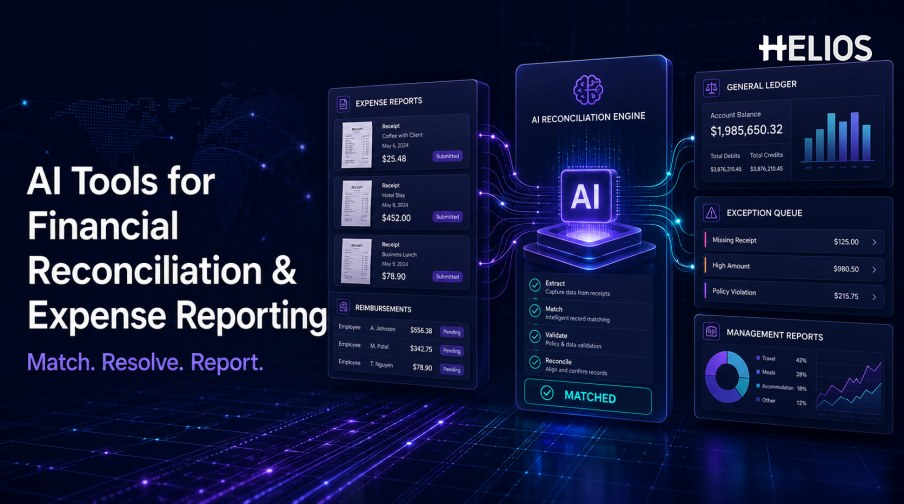
Financial reconciliation and expense reporting depend on the same underlying question: do the source documents, employee reports, approvals, reimbursements, card records, accounting entries, and management totals agree? When those records sit in separate systems, finance teams spend time exporting files, matching references, investigating differences, and rebuilding reports.
AI tools for financial reconciliation and expense reporting can assist with document interpretation, record matching, exception prioritization, and access to insights. The best tool is not a universal product ranking. It is the product that fits the organization’s data sources, matching rules, accounting structures, exception ownership, reporting needs, security requirements, and implementation capacity.
This guide explains the capability categories, evaluation criteria, workflow controls, and testing methods that matter. It also shows how Helios expense reporting and accounting integration can create continuity between approved expense records and downstream finance processes.
What Do AI Tools for Reconciliation and Expense Reporting Cover?
These tools support the controlled comparison of financial and operational records. In an expense context, the records may include receipts, invoices, expense lines, reports, approvals, reimbursement batches, corporate-card transactions, journal entries, integration responses, and ledger balances.
AI can help interpret unstructured documents, propose likely matches, summarize differences, or identify unusual patterns. Deterministic logic should still define authoritative sources, tolerances, period rules, approval authority, balanced-entry requirements, and the conditions under which a reconciliation is considered complete.
Key Capability Categories
A strong evaluation separates capability claims into specific finance tasks:
- Document and data capture. The tool extracts structured fields from receipts and invoices and imports records from expense, card, reimbursement, and accounting sources.
- Normalization and enrichment. Dates, currencies, merchant names, references, categories, entities, and dimensions are standardized before matching.
- Configurable matching. Records are compared by identifiers, amount, currency, date, employee, merchant, account, batch, or other business logic.
- Exception detection. Missing records, duplicates, amount differences, currency issues, rejected transfers, unusual patterns, and incomplete evidence are highlighted.
- Resolution workflow. Exceptions receive an owner, supporting evidence, status, comments, approval, and documented outcome.
- Accounting integration. Approved expense data and reconciliation status connect with journal preparation, posting responses, and ledger references.
- Expense and management reporting. Dashboards show spend, unmatched items, aging, exceptions, processing time, departments, entities, categories, and trends.
- Auditability and governance. The system records source data, rules, AI assistance, user actions, overrides, approvals, transfers, and corrections.
A Controlled Reconciliation and Reporting Workflow
An end-to-end process can follow these stages:
- Define authoritative sources. Identify which expense, card, reimbursement, bank, integration, and accounting records represent the expected outcome.
- Ingest and validate data. Load source records, confirm file completeness, and reject malformed or duplicate inputs.
- Normalize key fields. Standardize dates, currencies, merchant names, identifiers, categories, entities, and dimensions.
- Apply exact matching first. Use deterministic identifiers and values to clear straightforward records with a documented rule.
- Use AI assistance for ambiguity. Apply suggestions or similarity signals to records that lack clean identifiers, while retaining evidence and confidence context.
- Route exceptions. Assign missing, duplicated, mismatched, rejected, or unusual items to the appropriate finance owner.
- Resolve and approve. Document investigation, correction, adjustment, write-off, escalation, or other authorized treatment.
- Reconcile the accounting handoff. Confirm expected journal data, integration responses, posting references, and ledger outcomes.
- Publish reports and metrics. Show open items, aging, resolution time, recurrence, financial exposure, spend patterns, and control performance.
How to Evaluate the Best-Fit AI Tools
A product demonstration should use representative records and exceptions rather than a generic dashboard tour.
- Source coverage. Which expense, card, reimbursement, accounting, and document sources can be connected, and how are failed imports handled?
- Matching flexibility. Can finance configure identifiers, tolerances, dates, currencies, one-to-many relationships, and entity-specific rules?
- Explainability. Can reviewers see why a match or exception was suggested and inspect the underlying records?
- Exception workflow. Are ownership, aging, comments, attachments, approvals, escalation, and resolution history supported?
- Accounting continuity. Can approved expenses generate the required accounts, dimensions, taxes, currencies, references, and balanced journal structure?
- Reporting depth. Can users analyze spend and reconciliation status by entity, department, category, project, exception type, owner, age, and period?
- Audit trail. Are source versions, rules, AI outputs, corrections, approvals, overrides, transfers, and final outcomes retained?
- Security and governance. How are identity, permissions, encryption, retention, data location, administrator access, model-data handling, and change control managed?
- Implementation evidence. What data preparation, integration, testing, training, support, and ownership are required for the intended scope?
Common Tool Categories and Their Tradeoffs
Buyers may encounter several overlapping product categories. Each solves a different portion of the problem:
- Expense management platforms. Strong for employee submission, receipts, policy, approvals, reimbursements, expense accounting, and spend reporting.
- Accounting reconciliation platforms. Designed for broader balance-sheet, transaction, or account reconciliation across multiple sources.
- Corporate-card platforms. Strong for card feeds, receipt collection, transaction matching, controls, and card-specific close workflows.
- Document intelligence tools. Focused on extracting fields from receipts and invoices but may require another system for policy, approvals, accounting, and reporting.
- Business intelligence tools. Flexible for analysis and visualization but depend on clean upstream data and usually do not own the transaction-resolution workflow.
- General-purpose AI assistants. Useful for questions or summaries but require strong controls before they can participate in sensitive financial workflows.
Implementation and Control Best Practices
A staged rollout protects accounting accuracy and makes value measurable:
- Map the current process. Document sources, handoffs, rekeying, matching rules, exceptions, owners, accounting outputs, and reports.
- Establish a baseline. Measure unmatched volume, manual effort, correction rate, reconciliation time, aging, and recurring break types.
- Clean identifiers and master data. Standardize employee, merchant, account, entity, cost center, project, currency, and reference fields.
- Separate rules from AI suggestions. Use deterministic logic for mandatory controls and AI assistance for interpretation or prioritization.
- Pilot difficult cases. Include missing receipts, duplicates, refunds, split allocations, foreign currency, rejected transfers, late postings, and partial matches.
- Require documented resolution. Every material exception should have an owner, evidence, action, approval where required, and final status.
- Monitor after launch. Track false matches, missed issues, overrides, unresolved aging, failed integrations, accounting corrections, and user adoption.
How Helios Connects Expense Reporting and Accounting
Helios combines receipt capture, policy controls, configurable approvals, accounting-entry generation, and multi-dimensional reporting. Spark AI adds conversational assistance for claims, approvals, travel, and service. Within a reconciliation and reporting strategy, the platform contributes five connected capabilities:
- Structured expense data from the source. OCR captures receipt and invoice fields, while guided workflows collect the business context needed downstream.
- Earlier validation and policy control. Configured rules help prevent incomplete or out-of-policy reports from entering finance processing unnoticed.
- Exception-focused review. Approval Copilot supports reviewers with policy-aware claim analysis and relevant evidence.
- Expense-to-accounting continuity. Approved reports can generate accounting entries, reducing rekeying and preserving the connection between the expense and financial record.
- Reporting across spend and process. Multi-dimensional dashboards and customizable reports provide visibility into expense activity and management trends.
Helios also presents itself as an enterprise-grade provider with global experience and information-security credentials. Buyers should still confirm exact reconciliation scope, source connectors, matching rules, accounting responses, currencies, entities, audit requirements, security controls, and implementation ownership.
FAQs About AI Tools for Financial Reconciliation and Expense Reporting
Can AI fully automate financial reconciliation?
AI can assist matching, interpretation, and exception prioritization, but authoritative sources, tolerances, approval rules, accounting controls, and material resolutions should remain explicitly governed.
What is the difference between expense reporting and reconciliation?
Expense reporting records employee or business spending and its supporting evidence. Reconciliation compares those records with card, reimbursement, accounting, or other authoritative outcomes to confirm completeness and agreement.
What makes an AI reconciliation suggestion reliable?
The reviewer should see the source records, fields used, matching logic or confidence context, differences, and available alternatives. High confidence should not remove the need for controls on material items.
Should companies buy one tool or integrate several?
The answer depends on scope. An expense platform may cover submission through accounting handoff, while broader account reconciliation may require another system. Evaluate ownership, duplicate capabilities, data movement, and audit continuity.
Which metrics matter after implementation?
Track auto-match rate, false matches, unmatched aging, exception volume, resolution time, failed integrations, accounting corrections, report preparation time, overrides, and audit-trail completeness.
Finance teams evaluating expense-to-accounting continuity can review Helios expense management and reporting with their own source records, exceptions, journal requirements, integration responses, and management reporting questions.