
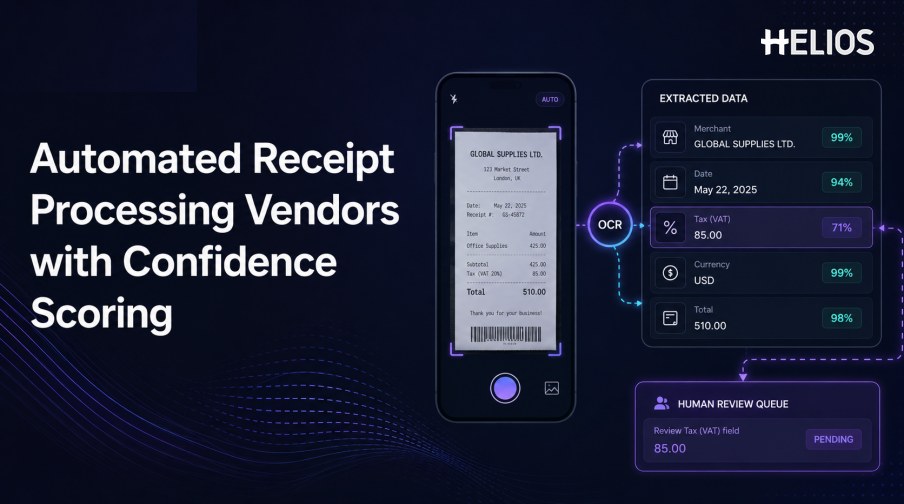
Vendors automated receipt processing confidence scoring is a search phrase used by buyers who need more than basic OCR. They want a system that not only extracts receipt fields but also indicates uncertainty, applies thresholds, and sends unreliable results to human review before the data enters expense or accounting workflows.
A confidence score can help prioritize work, but it is not the same as correctness. Scores may be calibrated differently by field, document type, model version, and vendor. Buyers should compare vendors using verified receipts and business outcomes rather than treating a displayed percentage as a universal quality measure.
This guide explains field-level confidence, threshold design, reviewer workflows, vendor testing, and how Helios OCR and expense controls can support data quality while exact confidence-scoring capabilities are validated during implementation.
What Confidence Scoring Means in Receipt Processing
A confidence score estimates how strongly a model supports a proposed classification or field value. Receipt processing may generate separate scores for document type, merchant, date, currency, tax, total, payment method, and individual line items.
The score should be interpreted within the vendor's documented calibration and test conditions. A score of 95 does not automatically mean that 95 percent of all fields are correct, and scores from different vendors are not directly comparable without a common data set.
Confidence Capabilities to Compare
Buyers should look beyond whether a score appears on screen.
- Field-level scoring. Separate the uncertainty of merchant, date, currency, subtotal, tax, total, and line items.
- Calibration evidence. Show how score bands relate to observed correctness on representative documents.
- Threshold configuration. Allow thresholds to vary by field, amount, country, document type, risk, and downstream use.
- Reason and source location. Display the receipt region, proposed value, alternatives, and reason a field was flagged.
- Model-version tracking. Record which extraction version produced the score and how changes are tested.
- Score availability through integration. Pass field confidence, corrections, and processing status into the expense workflow where required.
How Thresholds Should Route Human Review
The safest design combines confidence with business rules and financial materiality.
- Accept only defined low-risk cases. Use straight-through processing only when required fields, arithmetic, policy, and confidence conditions all pass.
- Ask the employee to confirm. Route moderately uncertain fields to the submitter when the source is readable and the correction is simple.
- Send material cases to finance. Escalate high-value, tax-sensitive, duplicate, conflicting, or policy-relevant fields regardless of model confidence.
- Reject unusable evidence. Request a new image when blur, cropping, glare, or damage prevents reliable interpretation.
- Capture every correction. Retain the original value, corrected value, user, time, source region, and final outcome.
- Review threshold performance. Monitor false acceptance, unnecessary review, correction rate, and downstream rejection by score band.
How to Test Vendors Fairly
Use the same ground-truth set and the same operational criteria for every vendor.
- Representative documents. Include countries, languages, currencies, receipt lengths, digital files, photographs, handwritten tips, and difficult images.
- Verified ground truth. Record the correct field values before processing and resolve ambiguous documents consistently.
- Accuracy by score band. Measure actual correctness for each field across confidence ranges rather than reporting one average.
- Coverage. Track how often the system produces a usable value and how often it returns blank, unsupported, or low-confidence output.
- Review effort. Measure clicks, time, context switching, and reviewer agreement for corrections.
- Downstream quality. Track policy exceptions, accounting rejections, duplicate risk, and later adjustments caused by extraction errors.
Integration and Governance Requirements
Confidence data has value only when the workflow can act on it.
- Expense-form integration. Prefill fields without losing the original image, score, or employee correction.
- Policy interaction. Combine model uncertainty with required fields, limits, categories, dates, and receipt rules.
- Role-based review. Define who may correct, approve, override, or release each type of field.
- Audit evidence. Preserve source, extraction, score, threshold, edit, approval, export, and accounting status.
- Security and retention. Review access, encryption, data location, model-data use, deletion, incident response, and monitoring.
- Operational fallback. Provide a governed manual path when the service or document type is unavailable.
How Helios Supports Receipt Data Quality Control
Helios publicly states that employees can photograph or upload a document and that OCR auto-fills relevant details. Its expense workflow also includes automated policy controls, configurable approvals, accounting-entry generation, and reporting. Spark AI adds conversational assistance for claims and approvals. These capabilities support five quality-control stages:
- Capture the original evidence. Mobile document submission keeps the receipt connected with the expense record.
- Reduce initial rekeying. OCR proposes document details for use in the expense workflow.
- Confirm and supplement data. Users can add the business context that a receipt alone cannot provide.
- Apply policy and approval controls. Structured values move through company rules and accountable review.
- Connect approved data downstream. Journal-entry generation and reporting support finance processing and monitoring.
Helios also presents itself as an enterprise-grade provider with global experience and information-security credentials. The public product page does not specify field-level confidence displays, calibration methods, or configurable score thresholds. Buyers should validate those features, plus receipt formats, languages, field coverage, correction paths, duplicate and transaction matching, accounting integration, and regional requirements.
FAQs About Automated Receipt Processing Confidence Scoring
What is a receipt-processing confidence score?
It is a model-generated estimate of support for a document classification or extracted field, interpreted within the vendor's calibration and test method.
Does a high confidence score guarantee accuracy?
No. Confidence is not proof. Required fields, arithmetic, policy, materiality, source evidence, and downstream controls still matter.
Should every low-confidence field go to finance?
Not necessarily. Low-risk corrections may go to the employee, while material, tax-sensitive, duplicate, or conflicting cases may require finance review.
How can two vendors be compared?
Process the same ground-truth documents and measure field accuracy, coverage, score calibration, review effort, and downstream quality by score band.
Does Helios publicly advertise confidence scoring?
Helios publicly describes OCR that auto-fills document details, but its site does not specify a field-level confidence interface. That capability should be confirmed in a tailored demonstration.
Teams can test Helios AI-Powered Receipt Capture using their own receipt set, required fields, low-quality images, review thresholds, policy rules, corrections, and downstream accounting requirements.